Thursday, March 10, 2022

Deeds far more inspirational than words

Still little word from the Russian Orthodox Church on the war in Ukraine.

What a powerful message it would be if senior clergy across Europe travelled to Ukraine. 

Wouldn’t it be a far more powerful message than asking us to pray for the people who are being brutalised by the Russian Army.

Words are easy, as are pious ones. And so many pious words are no more than empty cliches.

Pope Francis has sent two cardinals to Ukraine. They are Cardinal Konrad Krajewski, the papal almsgiver and Cardinal Michael Czerny, head of the papal office that deals with migration, charity, justice and peace.

Any news on their work and progress?

Tuesday, March 8, 2022

Form filling that would put years on you

This week’s Mediauis Irish regional newspapers’ column.

Michael Commane
All our worries, troubles and irritations fade into oblivion when we see what is happening in Ukraine.
 
It is unimaginable. It is incomprehensible, mothers with children, old women and men attempting to flee the place that is theirs. There are no words to describe what is happening.

And in the midst of all the suffering and misery I am embarrassed getting hot under the collar about my small troubles. 

I have been bemused in my dealings with a number of public bodies and State agencies. My two most recent skirmishes have been with Electric Ireland concerning my new smart meter, and then my saga in obtaining a new driving licence.

My Electric Ireland ‘conversation’ is ongoing, and I wait in trepidation the outcome of my NDLS experience. And just in case you don’t know, NDLS is an acronym for National Driving Licence Service. I’m weary of websites, acronyms and phone numbers that don’t work. 

My current three-year driving licence expires on March 14. On receiving my current driving licence in 2019 I had to undergo a medical examination including an eye test. Anyone 70 or over was obliged to do so. 

Three weeks ago I received a driving licence application form in the post. On this form it tells me that the NDLS is extending the age-limit for a medical cert from 70 to 75. But here’s the conundrum, they don’t tell you the exact date this is happening but tell you to check their website.
 
Confusing? Certainly. There is a telephone number on the form, which I phone. The number is not in service. Annoying? Certainly. 

I phone the relevant Government Department and a person gives me a number to call. I almost got the impression it was some sort of secret number. I eventually discover that the new 75 rule has now been activated. 

Has anyone out there seen or heard anything about this change to the driving licence? I get the impression they are trying to keep it a secret. As I struggle through the form I receive another body blow. 

On one page I am told I need to enclose a picture of myself and then on another page it expressly states that there is no need for photo identification.

I know in comparison to what is going on in Ukraine it is trifling stuff, but honestly I am demented with form filling, computer websites and hanging on like a fool waiting for someone to speak to on a phone.

But it is important to state that when the NDLS clears up a number of issues on the driving licence application form it has the potential to make it relatively easy to renew your driving licence. 

It seems I’m one of those people caught in the middle, neither one thing nor the other. In a way, it’s the story of my life.

As for finding information about my new smart electricity meter, after a number of phone calls and several attempts at downloading the relevant app, I’m still at sea.

And then there’s the story of verifying my MyGov id account, just to say they too give a phone number that does not work.

It’s all exhausting. I’m exhausted and confused. But I’m back thinking of the terror the people of Ukraine are experiencing. 

My troubles are indeed small.

Monday, March 7, 2022

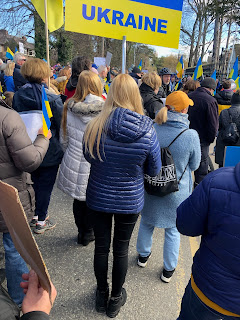
Rolling demonstrations outside the Russian embassy

There were rolling demonstrations

outside the embassy of the Russian Federation yesterday, indeed every day there are demonstrators at the gates of the embassy.

While there is now a permanent Garda presence at the embassy, demonstrators are peaceful and pleasant.

A group, made up of many Ukranian marched from the Ukrainian embassy to the Russian embassy on Orwell Road yesterday.

Sunday, March 6, 2022

‘Putin is Ivan the Terrible’s reincarnation’

Interesting piece in The Irish Times on Friday.

Ukrainian refugees arrive at the border village of Kroscienko in southeastern Poland. PHOTOGRAPH: EPA/DAREK DELMANOWICZ
Polish professor traces cause of invasion back to the 16th century
Lara Marlowe
The course of the war in Ukraine is writ large in history, says a leading historian of this southern Polish region on the border with Ukraine. Prof Lucjan Fac traces the cause of the war, and a pattern of Russian aggression, back to the 16th century.

“Vladimir Putin is the reincarnation of Ivan the Terrible,” Fac said as he showed me through the local branch of the Polish National Museum yesterday.

Ivan the Terrible (1547-1584), also known as Ivan Grozny, was the first tsar of all Russias, who tried to unite fragmented territories held by Slavic tribes.

“Ivan believed the religious and political doctrine which saw Moscow as the Third Rome, after the ancient Roman empire and Constantinople,” Fac explains. “This doctrine caused wars for centuries, and Putin is steeped in it. He thinks like the tsars. He sees democracies as unstable, because presidents and prime ministers come and go while he remains in power.”

Fac’s friend and fellow historian, Jan Jarosz, the director of the National Museum, believes Putin wants not to reconstitute the Soviet Union but to create “Great Russia”.

“In the tsarist mentality,” Jarosz says, ‘Big Russia’ [present-day Russia] plus ‘Little Russia’ [Ukraine] and Belarus equals Great Russia. Putin wants all eastern Slavs to unite in one Great Russia.”

Jarosz cites a press conference given by Putin five years ago. When asked what he would do about Ukraine, Putin responded: “Have you read the memoirs of General [Anton] Deniken?”

Territorial claims

The early 20th century Russian general wrote that whoever rules in Moscow must consider Ukraine to be a part of Russia.

Territorial claims based on history are not unusual. Israel bases its occupation of Palestinian land on the Bible. Serbia considered Kosovo to be the cradle of its identity, a role that many Russians ascribe to Kyiv. “History is like a knife,” says Fac. “You can use it to cut an apple. You can use it to cut bread. Or you can use it to kill someone.”

After Putin seized Crimea and part of the eastern Donbas region of Ukraine in 2014-15, Ukrainians grew accustomed to the idea they might lose those territories permanently, Fac says. His background as a military historian gives him insights regarding the future: “The Ukrainian army improved a great deal; some were even trained in Przemysl by Poles. They were prepared for the Russian army. Putin is sending the first line of Russian boys to their deaths, and he is ready to sacrifice a second and third line.”

After French president Emmanuel Macron spoke to Putin yesterday, the Élysée said that Putin’s goal “is to take control of all Ukraine”.

But Fac believes Putin wants only the eastern half of Ukraine, including its two biggest cities, Kyiv and Kharkiv. “He thinks there are too many pro-European nationalists in western Ukraine who would fight as partyzanci”, Fac explains, using the Polish word for second World War resistants. “Putin wants to push all civilians to the western part of the country.”

Polish commentators have been saying for months that Putin would start the war in February, when invasion routes are frozen. “The weather is helping him,” Fac says. “In the spring Russian armour will bog down in mud.”

Fac believes that Putin will seize only the “small Russia” mentioned by Jarosz, the museum director. “He will colonise it with Russians, which is what Russia has always done.”

Putin’s rapid disappearance would offer the only salvation for Ukraine, Fac says.

“Putin was counting on the weakness of the EU. I have been surprised by the unity of the EU. Putin is surprised too . . . Nobody knows how Ivan the Terrible died, but I don’t think it was of natural causes . . . The oligarchs and generals could turn on him. A putsch is possible. If they replace Putin with someone else, the conflict could end and sanctions could be lifted. The longer it goes on, the more irreversible the damage.”

Nationalism

A map on the wall of Jarosz’s office shows Poland at its apogee in 1668, when Polish power extended from the Baltic to the Black Sea. Poland’s eastern border was the border of present-day Ukraine then. “For 400 years, from 1385 until 1772, Przemysl and [the west Ukrainian city of] Lviv were the centre of Poland,” says Fac.

The Austro-Hungarian emperor Franz Josef granted Poland autonomy in 1867, which prompted the first stirrings of Ukrainian nationalism, Fac says. When the empire ended with the first World War, Poles and Ukrainians fought, as chronicled in Fac’s recent book, Forgotten War, the 1918-1919 Polish-Ukrainian War. Poland won, and kept Lviv until 1939.

Over the past 600 years, all or parts of present-day Ukraine have been, in succession, Polish, Austro-Hungarian, Polish again, Soviet and finally, since 1991, independent Ukraine.

Soviet and German forces converged on Poland in 1939, splitting the country in two. The San river, which runs through Przemysl, was the demarcation line. Russia deported thousands of Poles from the east bank of the river to Siberia. Germany wiped out the Jewish quarter on the west bank, sending its inhabitants to the Belzec extermination camp.

Today, the west bank, where the National Museum is located, is an empty quarter of parking lots and bus stops.

The museum contains photographs of many murdered Jewish inhabitants of Przemysl, and liturgical items from their synagogues. There are also photographs of a smiling Ukrainian woman greeting Adolph Hitler, and a Ukrainian Orthdox priest blessing the Ukrainian SS division.

Yet today Poland is perhaps Ukraine’s closest ally in its hour of need. The airport at Rzeszów, 91km from Przemysl, is a hub for arms shipments to Ukraine, and Poland expects to receive a million Ukrainian refugees, to whom it offers food, lodging, transport and sympathy.

“We realise we have much more in common with Ukrainians than any other people,” Fac says.

But he fears the war signifies his own failure as a historian. “These wars repeat themselves all the time and we are surprised; we are still not learning. I feel it as a personal failure.”


Saturday, March 5, 2022

Gerard McCarthy, a scholar and kind gentleman

The link below is to a story in The Irish Times digital version yesterday.

I sat beside Gerard McCarthy in second class in primary school and I can still remember him. I remember him as a kind and helpful little boy. One felt secure and protected in his company, at least I did.

Gerard has a brother a priest in the Dublin archdiocese.

https://www.irishtimes.com/culture/books/gerard-mccarthy-1949-2022-an-appreciation-by-chris-agee-and-manus-charleton-1.4811390

Friday, March 4, 2022

Cologne archbishop offers his resignation to Pope Francis

The cardinal archbishop of Cologne has offered his resignation to Pope Francis.

There has been ongoing controversy about how Archbishop Rainer Maria Woelki handled cases of clerical child sex abuse in the archdiocese of Cologne.

Was he completely open and honest, did he attempt to conceal issues? Has he shown respect and dignity to victims and indeed to the people of the archdiocese? Is he a man capable of dialogue?

Respect, dignity and dialogue are important qualities.

Woelki is not the only German archbishop who has offered to resign.

From the Catholic News Agency:

https://www.catholicnewsagency.com/news/250542/german-catholic-cardinal-woelki-submits-resignation-to-pope-francis-for-2nd-time-after-period-of-leave

Thursday, March 3, 2022

European bishops stand in front of the tanks in Ukraine

There has been little word from the Russian Orthodox Church on the Russian invasion of Ukraine.

Christian bishops around the world have called for prayers for the people of Ukraine.

It is a fine gesture.

But what might happen if say all the Irish bishops, indeed, all European bishops went to Ukraine and stood, dressed in their robes, in front of the Russian and Ukrainian tanks.

Wouldn’t such an act make their prayers so real and powerful. And would Putin really order the tanks to keep rolling?

Former Irish ambassador Joe Hayes on life in Kyiv

Below is Monday’s A Word in Edgeways aired on RTE Radio 1.

https://www.rte.ie/radio/radio1/clips/22068213/

Wednesday, March 2, 2022

Hospital staff fill a truck heading for Ukraine

Staff in our hospital yesterday organised a collection of goods for the stricken people of Ukraine.

By late afternoon a large room in the hospital was filled with boxes and bags, all filled to the brim with merchandise for Ukraine.

Close to 6pm we began to fill a truck, which later left for a storage depot in the city.

One of the men, who arrived with the truck is from Ukraine. He’s a young man. We spent less than an hour loading and in that time there was not a word from the Ukranian. It was all work, fast work. What must he have been thinking, lifting those boxes on to the truck?

And while we were loading that truck, Russia, no not Russia, rather the mouthpiece of a dictator was telling the people of Kyiv to leave the city.

This is reprehensible and it must be stopped. How?

Tuesday, March 1, 2022

Grateful to have a roof over my head

This week’s Mediahuis Irish regional newspapers’ column.

Michael Commane
On the night of Thursday, February 17 Eunice made herself felt outside my house. Shortly after 11pm she began to growl and get quite angry. And the rage and anger lasted all night, eventually subsiding sometime after 7am on Friday morning.

There were times during the night when I was scared the roof was going to be ripped off. The howling of the wind was relentless. I had never before heard a gale or storm rage for so long. I was relieved to hear on the radio news that it would blow itself out by 8am, at least in my part of the world. But shortly after that I lost power in the house, which meant my radio was gone. 

I learned a good lesson, always make sure to have batteries on stand by to insert in your radio. Fortunately the power outage was short and we had electricity back within 30 minutes. A friend of mine, living in South Kerry was without power all day on the Friday. He’s an engineer by trade and is always toying with the idea of alternative ways of supplying power to his house. Eunice and its aftermath might be the catalyst that will turn his ideas into action.

But both of us began a conversation on what life must have been like before the advent of electricity.

It’s not that long ago at all since we first got our homes wired up. I clearly remember the arrival of electricity to my granduncle’s house and farm on the Tipperary Kilkenny border in the early 1960s.
 
The winds have abated, sadly a staff member of Wexford County Council was killed while working on a clean up operation, and a number of homes and buildings were damaged as a result of the three storms.

On television news I saw two men being interviewed beside their home, which had been destroyed by a large tree. I was impressed with how cool and calm they were. I say that because on the night of February 17 I was scared stiff in bed that my roof was going to go. I had that feeling of helplessness, that added to my real fear. Outside it was dark, the street was empty. What actually would I do if the roof went? It was a horrifying experience.

I’ve been thinking about it since. Maybe that sense of fear and dreading gets worse as we get older.
 
The following Saturday and Sunday more storms landed on us. This time I was away from the epicentre.

Watching the news on Sunday evening I saw an elderly lame woman shuffling about on the Ukrainian Russian border. She looked lost and in great pain. I can’t imagine what she is suffering. 

Everyday we see the most shocking of stories on our televisions and in our newspapers. We switch to another channel, turn the page of the newspaper. We do, at least I do, become immune to the plight and worries of other people.

Do we ever have a clue what hell other people suffer? The only time we get a real sense of hell and suffering is when it directly happens to us.

That’s why it’s so important always to offer the hand of friendship and help to those in need and suffering.

Empathy goes a long way in making our lives more tolerable.


Monday, February 28, 2022

The Russian Army has to be stopped

It is highly unlikely that the Russians will allow street battles in any Ukrainian towns and cities. Does that mean they may now be in some sort of dilemma?

The Russians learned much from the battle of Stalingrad, which was waged between August 1942 and February 1943.

The Germans first bombed the city almost to a point of annihilation. In so doing they left the city in a perfect state for Red Army snipers and also made it almost impossible for German tanks to negotiate the streets of the city of Stalingrad.

The Russians will not let that happen in Kharkiv or Kyiv or indeed any Ukrainian urban area.

There is indeed something ironic how President Putin has taken so much from Hitler’s playbook.

Over 100,000 people demonstrated in Berlin yesterday to express their disapproval of the Russian invasion of Ukraine. People all over the world came out in force to say No to Putin.

Today People Before Profit held a demonstration outside the Russian embassy on Dublin’s Orwell Road against the invasion.

It is incomprehensible what is happening. And as Independent TD Cathal Berry said today, the Russian Army has to be stopped.

Putin’s bizarre speech wrecks his once pragmatic image

An interesting piece in The Guardian.

https://www.theguardian.com/world/2022/feb/25/its-not-rational-putins-bizarre-speech-wrecks-his-once-pragmatic-image

Sunday, February 27, 2022

While Putin lies Germany sends weapons to Ukraine

Germany has reversed a historic policy of never sending weapons to conflict zones, saying the Russian invasion of Ukraine was an epochal moment that is imperilling the entire post-World War II order across Europe. 

Germany will send 1,000 anti-tank weapons and 500 Stinger missiles to Ukraine, German Chancellor Olaf Scholz said that this marks a reversal in Berlin's restrictive arms export policy.

Yesterday German Foreign Minister Annalena Baerbock expressed great anger in how the Russian president had lied to her, the German people and the entire world.

Ukrainian President Voldymyr Zelenskyy when offered safe exit from Ukraine replied: Its not a ride I want, its weapons.

Every day Zelenskyy proves himself to be quite an amazing man, a great, courageous and charismatic leader.

President Putin has told the Russian people that the leadership in Ukraine is made up of Neo Nazis and drug addicts.

It’s doubtful that Voldymyr Zelenskyy is a drug addict. The man’s first language is Russian and actually he is a Jew.

President Putin has a penchant for telling barefaced lies.

What is the Russian Orthodox Church saying about  President Putin?

Zelenskyy is an example to the world. When elected president the world smirked at this comedian being elected. The world must right now hold this man in the highest of esteem.


Saturday, February 26, 2022

We need to feel wanted and respected

The Thinking Anew column in The Irish Times today.

Michael Commane
There is a comforting and underlying theme running through tomorrow’s liturgy.

The opening antiphon introduces us to the idea that the Lord is our protector, who saves and frees us, indeed, even delights us.

The author of the book of Ecclesiasticus talks about how an orchard is judged by the quality of its fruit. St Luke in the Gospel advises us to be sparing in our criticism of one another and uses that often quoted text: “Take the plank out of your own eye first, and then you will see clearly enough to take out the splinter that is in your brother’s eye.” (Luke 6: 42).

And Luke too paints the picture of how the good tree  produces good fruit.

Reading across all that literature one gets a strong impression how important our own personal nurturing is for our development, how vital it is to feel at home and indeed good in the environment in which we find ourselves.

It is such a cherished and wonderful gift to be able to be ourselves, to be open and honest with another person. Where and when it happens we can easily take it for granted but that is never to take away from the extraordinary privilege it is to be completely open with another person. It is something that happens in all sorts of relationships. It is probably at its most fundamental and strongest in the relationship between child and parents. There are no ifs and buts, it is total commitment, total loyalty, total openness. And when it doesn’t work it can lead to turmoil and disaster.

But at some level or other we all expect to be nourished and nurtured, in other words most of us want to be accepted and respected by other people.
 
And that means in our homes, our places of work, our societies. When people feel alienated and outcast they can be ever so easily driven to paths of destruction and violence.

Just scratch the surface of anyone who behaves badly or in a manner that is unhealthy for them and society, you will quickly find a story of alienation, someone who feels unwanted and never respected. It never pays to hurt other people. As sure as day follows night, that hurt will cause a ripple effect somehow or someway in a time and a place that may never make sense or cause suspicion to the casual onlooker.

St Luke admonishes the hypocrite. Admittedly, hypocrites stretch the patience of the best of people. From my experience in the classroom young people have a refined sense of spotting hypocrites and then despising what they do. But again, the oxygen that gives life to the hypocrite is a place where she or he feels they have to behave in such a way so as to deceive or fool someone. 

And that behaviour is anathema to an open and loving environment. It’s important to add, most of us find it far easier to see the hypocrite in the other person than in spotting our own hypocrisy.

At present, under the initiative of Pope Francis, the Catholic Church is in the process of talking and discussing about how it can further the Word of God in the world, in the place where it is right now. It’s being called a synod and unlike previous synods, it is hoped that Catholics of all rank and stature can have their say, that their voice will be heard.

Pope Francis’ personality is written all over it, the pope, who on the evening of his election, finished his address to the people in St Peter’s Square with those two simple words 'Buona sera’. Those two words touched the hearts of millions of people that night. It heralded a break from a formalism that seems at times to strangle the church.

It sounded so far removed from doctrine, and canon law, from prince bishops, their titles and palaces. It spoke directly to people of good will, who want to feel at home and loved in their church.

There is nothing highhanded or authoritarian about those two simple words and yet they convey such a sense of warmth and indeed respect. Anytime anyone ever greets me with such an expression, calling me by my name, I feel respected and accepted too. I listen to them.

At present Christian churches are in the strangest of places. There are myriad problems. But isn’t it staring us in the face that we will get nowhere unless we feel at home and wanted in our church and for that to happen, leadership needs the wit, God’s grace and the simple common sense to guide and nurture people in such a way that we will feel wanted and respected. Nothing less is going to work.

All the palaver, all the words, all the structures, all the committees will head towards a dead-end unless there is genuine respect and honest concern for the other person.

Isn’t that what tomorrow’s liturgy is all about?

Friday, February 25, 2022

A day we'll remember where we were, what we were doing

In the years to come we will all remember what we were doing on Thursday, February 24, 2022.

Yesterday morning President Vladimir Putin in his address threatened any nation who supports Ukraine. He threatened us with such a disastrous consequence, the likes of which we have never seen. Does that mean nuclear war?

Last evening on German television station ZDF, German economics minister Robert Habeck gave an impassioned  analysis of the Russian invasion of Ukraine. He looked and sounded worried but spoke with great honesty and clarity. Earlier in the day he had visited the Ukrainian embassy in Berlin and spoke of the worry he saw etched on the embassy staff. He saw tears in the eyes of one man.

Interesting to compare the words, the language, the gestures of an democratically elected politician with the behaviour of Vladimir Putin.

Robert Habeck is vice chancellor and a member of the Green Party.

Just over a week ago Vladimir Putin told the world that Russia had no intentions of invading Ukraine.

The world has too many liars. 

There’s much to learn from history. On this day, February 25, 1922 Tiblisi, the capital of Georgia fell to the invading Russian army and was declared the Georgian Soviet Socialist Republic.

Last evening US General Petraeus said that Vladimir Putin has not only assaulted Ukraine but he has also assaulted democracy.


Thursday, February 24, 2022

An Irishman’s Diary in The Irish Times yesterday

An eye-catching topic in The Irish Times yesterday.

An Irishman’s Diary

Elizabeth Hurley: her surname is still interchangeable in places with Commane (from camán). But that seems to have been the result of a phenomenon called “pseudo-translation” because the suspected Irish originals of Hurley had nothing to do with hurling. PHOTOGRAPH: BRYAN O’BRIEN
ELIZABETH HURLEY: her surname is still interchangeable in places with Commane (from camán). But that seems to have been the result of a phenomenon called “pseudo-translation” because the suspected Irish originals of Hurley had nothing to do with hurling. PHOTOGRAPH: BRYAN O’BRIEN

It’s a peculiarity of Ireland, or at least it used to be, that not only do most families here have two surnames, quite a few of them have three.

There is the Irish original, of course, and there is the anglicised approximation of that, by which most people now go. But there is also often, or there was, an English translation of the original, having no visible similarity with the other two.

Examples include Black (for the anglicised Duff, from the Irish dubh), Bird (for Heaney or McEneaney, from éan), and Fox (for Shanahan and its variants, from sionnach).There is also Bishop for McAnespie, Judge for Breho/eny, Rabbit for Cunneen, Small for Begg or Beggan, Short for McGirr, and so on.

Hurley is a common but exceptional case. It is still interchangeable in places with Commane (from camán). But that seems to have been the result of a phenomenon called “pseudo-translation” because the suspected Irish originals of Hurley had nothing to do with hurling.

Among the more direct translations, meanwhile, there are some quirky examples. Quirk(e) is one of them. Irish families with that anglicisation could also sometimes go by the name Oat(e)s, the translation of the root word coirce.

Then there is the exotic case recorded once by the register of Cappoquin district, Co Waterford, when a man named Bywater came in to register the death of his brother, one Michael Sruffaun: “On being interrogated as to the difference in the surnames, he said that he was always known by the name Bywater but his brother by the name Sruffaun.” As the registrar added by way of explanation: “Sruffaun is a local form of sruthán, an Irish word for a little stream.”

That’s among the examples cited in a 1909 book on Irish surnames, by Robert E Matheson, then retiring as the country’s registrar-general.

Matheson had encountered many similar confusions in his work: “For instance, in the middle of a marriage certificate, there would appear such a name as Mary Hurley, while the signature would appear as Mary Commane, the latter being the Irish for hurley stick.”

As he explained, this duplication went back to the early centuries of English rule, and attempts to impose standardisation in the Pale at least. One statute of 1366, for example, ordered that subjects adopt English names, “leaving off entirely the manner of naming used by the Irish”.

Another, in 1465, decreed “that every Irishman that dwells betwixt or amongst Englishmen in the county of Dublin, Myeth, Uriell, and Kildare shall take to him an English surname of one town, as Sutton, Chester, Trym, Skryne, Corke, Kinsale; or colour, as white, blacke, browne; or arte or science, as smith, carpenter; or office, as cooke, butler...[etc].

Hence the complicated “fossil history” of Irish surnames, as Matheson called it, although even in his time, the process of anglicised versions being replaced by direct translations continued.

The McRorys of Ulster, for example, were increasingly styling themselves “Rogers”, he wrote, while in the Riverstown district of Sligo, the registrar had noted of one local surname “that they were almost all ‘Brehenys’ some time ago, but are now becoming Judge(s)”.

The history of surnames in Ireland is further complicated by the many English and Scottish ones introduced directly in the various plantations.

An unusual but interesting example is Stoney.

The best known Stoneys of Irish history were a big-house family of engineers who settled in Tipperary, mainly. Their descendents include Alan Turing, the code-cracking genius of the second World War, whose mother was an Ethel Stoney from Borrisokane.

But as one Lieutenant Colonel FS Stoney pointed out in a letter to this newspaper once (in response to Matheson’s book), there were also some indigenous Stoneys, descended from an ancient sept named Maolclochach, which had been anglicised as Mulclohy before going full English.

Colonel Stoney regretted that his family – originally Danish, via Yorkshire – could not claim such noble Irish lineage. On the other hand, he was relieved that they were also thereby exempt from an ancient curse associated with Coney Island in Sligo.

That used to be Inismulclohy, after a local family. And tradition has it that St Patrick once planned to link it with the mainland via a causeway. Unfortunately, this changed when his hostess there, “a woman named Stoney – i.e. Mulclohy, served up a roast cat for his dinner instead of the roast rabbit he ordered.”

The local rabbit population, after which the island is now named, must have multiplied since. The humans were less fruitful. According to the legend, St Patrick prayed that the native Stoneys would never multiply sufficiently for there to be four of them to carry a relative’s coffin. His bridge project was also cancelled.


Wednesday, February 23, 2022

Seventy eight years ago it was the Chechens and the Ingush

An interesting if not ironic anniversary.

On this day, February 23, 1944 the former Soviet Union began the forced deportation of the Chechen and Ingush people from the North Caucasus to Central Asia.

In 1944 Josef Stalin was General Secretary of the Communist Party of the Soviet Union.

Tuesday, February 22, 2022

Bishops uneasy with church teaching

This week’s Mediahuis Irish regional newspapers’ column.

Michael Commane
Three German Catholic bishops, Heiner Koch, Reinhard Marx and Georg Bätzing made extremely interesting comments in recent weeks.

Koch is the archbishop of Berlin, Marx the archbishop of Munich and Freising, and Bätzing bishop of Limburg and also president of the German bishops’ conference. 

Bätzing’s predecessor, Franz-Peter Tebartz-van Elst was engulfed in scandal, ranging from flying first class from Germany to India and building himself a palatial home. When the media found out about his expensive travel requirements the diocese employed a top legal firm to bat for him. But in the end it didn’t work and eventually Pope Francis in 2014 accepted the resignation Tebartz-van Elst, who had become known as the bishop of bling.

Marx, no relation to Karl, has been in the news because it was in his diocese that a predecessor of his, Pope Benedict, the then Joseph Ratzinger, has been accused of being economical with the truth when dealing with a number of clerical child sex abuse cases during his time as archbishop of Munich.

The three bishops have expressed their views on Catholic Church teaching on sexuality. On the popular Anne Will television programme some weeks ago Bätzing clearly said that Catholic Church teaching on sexual matters would have to change. All three bishops in the days following that programme said that there would have to be a move towards ordaining women and allowing priests to marry.

For three senior German bishops to speak publicly and clearly about such a taboo subject is a moment in German Catholic history, a moment in church history. Since then more German bishops have spoken of the need for change.

The debate is happening because of the Munich affair and the work of the worldwide synod that is currently taking place under the initiative of Pope Francis.

On the exclusion of women to the priesthood Bätzing said: ‘But I must honestly say that I am also aware that these arguments are becoming less and less convincing and that there are well-developed arguments in theology in favour of opening up the sacramental ministry to women as well.’

In an interview in a national daily newspaper Cardinal Marx said: ‘It would be better for everyone to create the possibility of having both celibate and married priests. 

‘For some priests, it would be better if they were married. Not just for sexual reasons, but because it would be better for their lives and wouldn’t be so lonely.’

Archbishop Koch said that although celibacy is a ‘strong testimony of faith’, it does not have to ‘be the exclusive route to priestly ministry.

These days, listening to the German bishops speak in prophetic words, I’m reminded of people who lived in the former East Germany, who objected to the system but nevertheless went along with what the party apparatchiks said, as they were afraid to speak their minds. They lived troubled lives, never being free to voice their opinions. The Berlin Wall falls and everything changes. All the theories and reasons the people were given no longer made an ounce of sense.

Life is a mystery and the moral of the story surely is never say never. 

Monday, February 21, 2022

28 years after the 28-year-old Berlin Wall

On Saturday the Berlin Wall

had been gone for 10,316 days, also representing the number of days it had divided the city.

It was erected overnight on August 13, 1961. Between then and 1989 the East German authorities spent large sums of money on reinforcing the Wall and developing sophisticated means of making it almost impossible to cross from East to West Berlin.

140 people were killed attempting to cross from East to West Berlin, more were killed between 1961 and 1989 in attempting to cross the inner German border.

The Catholic diocese of Berlin was one of the few organisations that spanned East and West Berlin, with the Bishop of Berlin living in East Berlin. The diocesan cathedral, St Hedwig’s was and is in Bebel Platz, which was situated in East Berlin.


Sunday, February 20, 2022

China, commerce and Taiwan

Volkswagen sell approximately five million cars annually in China, which is more than half its world-wide sales.

China is Ireland’s fifth-largest market for Irish goods, accounting for €10 billion worth of exports in 2020, most of which were agrifood products.

What will happen when China turns up the ante on Taiwan?

Saturday, February 19, 2022

Hospitals pay out massive €2.4bn in malpractice claims

The State has paid out €2.4 billion to settle 6, 289 hospital claims over the last 20 years.

The claims involve patients, service users, employees and members of the public across all the State’s acute hospitals.

In that period the South/South West Hospital Group, which is made up of Cork University Hospital, University Hospital Kerry, University Hospital Waterford and South Tipperary General Hospital, has paid out over €638 million in compensation. 

Sinn Féin TD David Cullinane said: “There seems to be a repeated pattern every year. Yes, mistakes can be made, but you have to learn from mistakes and put measures in place."

Friday, February 18, 2022

Disowning family faith feels like breaking link with ancestors

Interesting article in The Irish Times yesterday. 

Joe Humphreys

A puzzling feature of Irish society is the way in which people who have no time for religion turn to the church for key events – like births, marriages and funerals – while also, in many cases, valuing a Christian education, as though a parent’s duty is to give their child a faith to reject.


A degree of nostalgia may lie behind it. As a lapsed Catholic, I feel that completely disowning the faith of my family is a bit like severing a link with my ancestors.


Being born into a faith has also given me an appreciation of what it’s like to believe in an omnipotent being – something that binds me to the majority of the world’s population. It is only in certain countries, mainly Weird (western, educated, industrialised, rich, and democratic) ones, that children grow up without ever having experienced a relationship with god.


That’s not necessarily an argument for rushing back to the church. Rather, it’s an invitation to reflect on what – if anything – has been jettisoned in our transition to secularism.


That invitation takes better shape against the backdrop of a new book by NUI Galway philosopher Felix Ó Murchadha, kiwho places our current situation in a centuries-old context.


For most of human history, people understood themselves as products or playthings of the gods. We depended on godly “grace” for happiness, and our ultimate goal was heavenly “salvation”.


Something changed about 500 years ago in the Christian world, Ó Murchadha argues, when sceptical thinkers like Montaigne started to question the relationship between God and individual. Under this new outlook, which – according to Ó Murchadha – reached its apotheosis with Immanuel Kant, “the self transforms from a being directed towards salvation in an afterlife to a being seeking to create itself and in doing so achieve its own salvation”.


From this modern perspective: “Happiness is no longer a return to the divine or to the eternal, but is that which is to come in a new world, a world of human making, moulded from an indifferent nature,” Ó Murchadha writes in The Formation of the Modern Self: Reason, Happiness and the Passions from Montaigne to Kant (Bloomsbury).


Crucially, he says, early modern thinkers did their work hand-in-glove with theology. There is a tendency today to depict sceptics like Montaigne as atheists in all but name; however this depends on a “supposition of insincerity in some of the utterances of these philosophers”.


Thinking critically about the possibility of a relationship to a god, or gods, therefore, binds us to a surprisingly rich tradition of philosophy. That said, any worthwhile theoretical exercise must take account of science.


In this regard, Ó Murchadha looks forward as well as back as he considers how the dawn of the Anthropocene – an era in which humans are creating geological change – is giving rise to a new understanding of self.


If humans are now in control of nature to the extent that we can undo creation have we, perversely, made ourselves into gods? And if so who, if anyone, will save us? Never afraid to ask the deep questions, Unthinkable puts Ó Murchadha in the interview seat this week.


You say Montaigne is “the father of

the Modern self”. How so? “Montaigne was a French author of the 16th century, living in a time of uncertainty, crisis and civil war. Within this context, he withdrew from the world, literally in the sense of stepping back from public life, but also metaphorically in stating that he could not speak with any certainty about anything except his own experience.


“In his essays he tests himself. The French word ‘essai’ means ‘test’ – we owe its present literary sense to Montaigne. He tests himself by exploring what is strange to him – writings from the Ancients to his own day, reports from the Americas of exotic peoples, his experience of others.


“What he discovers through this process is a fragmented, continually changing self, which can make no claims beyond its own experience of the world. All of this marks a shift from an understanding of the self in terms of pre-given social and cosmological hierarchies to understanding everything on the basis of the self’s experience.


“What we find here is a sense of self that escapes categories and structures, a kind of anarchic freedom that remains a powerful force in modernity, even when opposed by the counter-tendency to rational order.”


You say there is a tendency to assume early-modern philosophers were insincere when referencing theological sources but is there not a case for saying that many such philosophers would have been atheists had atheism not been a punishable offence?


“My book begins with Montaigne and ends with Kant, both of whom said that they may not write all they think, but would never write anything they did not think. I see no evidence for doubting their sincerity here, nor indeed the sincerity in this respect of Descartes, Pascal, Spinoza, Hume or Rousseau.“We need to be clear, also, that ‘theological’ sources does not necessarily mean ‘theistic’. The very idea, for example, of the self turning within itself to find the truth, is rooted in a theological understanding of the self as finding peace and enlightenment internally, rather than in the world.


“Furthermore, there are many forms of atheism. Spinoza, who begins his ethics with a ‘proof’ of existence of God, could be accused of atheism because his account of God was not that of the creator of nature, but rather of nature itself. In Spinoza too – and Kant – we find some trace of the later atheism of Marx, Nietzsche and Freud, which understands religious belief in terms of an underlying need or desire.


“The attempt to prove the non- existence of God – Dawkins et al – is for the most part a later development. Importantly, with the possible exception of Hume, an account of God remains significant for the thought of the philosophers of this period. What is most contested philosophically in this period is not the existence of God, but the nature of God.”


How is the age of Anthropocene forcing us to reexamine what it means to be human?

“As I understand it, the modern account of the self was formed in response to the crisis of the Medieval world, namely the radical breakdown in the European understanding of God/religion, of the cosmos, of geographical space, of politics, of society, of science. We are living through a time of comparable crises with respect to the environment, democracy, economy, gender and many other domains.


“One of the crucial moves of modernity was that the divine was evacuated from nature and the Medieval distinction of creator and created gave way to the modern distinction of human – as self – and nature. This is no longer tenable.


“In the Anthropocene we have to start not from the projection of the self, but from the expressive totality of the natural world. What I mean by that is that we need to think not just of the human as self, but of all things as being or becoming entities which relate to all others as selves.


“The human self in such a context has to find itself as one kind of self among others within nature. This does not mean reducing the human self to a cog in the machine of nature, but rather to rediscover nature as much more than a machine, as the interacting, interlacing relations of multiple centres of self- expression.


“Just as modernity involved a transformation of the understanding of self, nature and divinity which has led to the Anthropocene, our present crises call for a new understanding not alone of the self, but of nature and divinity too.


“The self which emerges from the present crises needs a humility with respect to nature and a receptivity to a sense for its existence which precedes and envelops it, while remaining free of all dogmatic claims.”

Tuesday, February 15, 2022

The persuasion of a ‘lapsed Protestant’

This week’s Mediahuis Irish regional newspapers’ column.


Michael Commane

I’ve been working as a hospital chaplain for five years and I’m forever saying that what I hear and see every day is certainly the topic for a book. It’s time to start.


The philosophy, theology, the common sense, the stories that I hear from people every day have filled my head with wonder.


I have a list of questions that I don’t ask patients. I never ask a patient what religion they are, nor do I ask them what their occupation is or whether or not they are married. In my job I think it’s important that I don’t put labels on people. It’s a matter of both of us meeting one another as if our stories are beginning at that moment for each of us. The conversation can flow from there and if the story unfolds, well and good.


When it comes to religious classification I was somewhat bemused when someone said to me that they were a ‘lapsed Protestant’. I’d never heard that before and certainly not in a hospital context. Of course I‘ve often heard the term ‘lapsed Catholic’, at least, that was when far fewer people were walking away from the institution.


On a few occasions people have said to me that they are ‘of another persuasion’. When I hear it I feel as if my feet are stuck to the floor. It is said in a sense of kindness and politeness but I keep wondering how really different is our ‘persuasion’.


Only recently before heading to the hospital chapel to celebrate Mass someone used that term to me. I can only presume the person was a Protestant. 


It set me thinking about the Eucharist and what exactly their views and opinions are on the Catholic understanding of the sacrament. Indeed, my mind went off racing and I was asking myself what does the Eucharist mean to Catholics? Ok, that could bring us down a long road of theological discourse.


Then again, what exactly are the distinguishing features that separate Catholics and Protestants? I’ve often been told in order to get a full picture of the Catholic understanding of the Eucharist one would need to be familiar with the metaphysics of Aristotle and his understanding of categories. The theology of grace is another conundrum that divides us. I’m thinking of all these matters that divide us and most of us have not a clue about what we are talking. 


Better said, these issues have no real meaning for the majority of Christians. The ideas and prejudices we have about one another make no sense and are most unhealthy. Mark Twain’s comment: ‘The easy confidence with which I know another man’s religion is folly teaches me to suspect that my own is also’ is worth a moment of thought.


From my five years working as a hospital chaplain I’ve learned the importance of accepting people where they are, listening to them, trying to walk in their shoes, making a genuine effort to appreciate the stories of their lives. And isn’t it only in that context that any sort of genuine conversation can take place?


Come to think of it, we are all of different ‘persuasions’. And I always find it intriguing when people tell me they are ‘lapsed’. I’m never quite sure what it means. Scratch the surface and you will be surprised at the wealth of wonder and faith you might find.


Featured Post

Rural Ireland wants to deport foreign criminals

Eighty-five per cent of people in rural Ireland believe that  foreign nationals convicted of crimes should be deported. There are approximat...