This week’s Mediahuis Irish regional newspaper’s column
Tuesday, September 14, 2021
A joy in reading the printed version of a newspaper
Michael Commane
It’s a faint memory with me but I can still remember paper sellers shouting out on the streets of Dublin ‘Herald, Mail or Press’.
The Evening Mail sold in Dublin and ceased publication in 1962. The Evening Press sold across the State and ceased publication when Irish Press Newspapers closed in 1995 and the Evening Herald, also a nation-wide newspaper, was renamed The Herald in 2013 and became a morning publication.
Many people, especially in Dublin bought two daily newspapers.
The newspaper trade has undergone extraordinary change.
Is the demise of the printed newspaper now inevitable? Today everyone is glued to their smartphones. But are they reading newspapers?
Why buy a hard copy newspaper when you can read it all on your phone?
I have been toying with subscribing to the digital version of a newspaper. But I am having second thoughts.
I have the Saturday edition of a national newspaper delivered to my door and I spend an inordinate amount of time reading it over breakfast. It’s a sort of weekly indulgence with me.
It’s many years since I have bought a Sunday newspaper but two weeks ago I bought the Sunday Independent.
I’ve been thinking about it since. It has dawned on me there is an art in newspaper reading, especially at the weekend if you have free time to spend reading the newspaper. I think it is a whole different experience from reading it on an electronic device.
There is a joy, indeed, an art form in spreading a newspaper out on a table. My modus operandi is at first to turn over the pages and pick out a topical or major story that might interest me.
That particular Sunday I leafed through the main section of the paper and the first story I read was Gene Kerrigan writing about ‘real scandals’.
I’m interested in politics so naturally I read all the shenanigans surrounding the Katherine Zappone affair and whether or not Micheál Martin might be for the high jump. I checked the Newsbrief and saw no one won the Lotto and that a ‘homemaker’ had left €8.4 million in her will. I then put the main section aside and read what Joe Brolly was saying for himself.
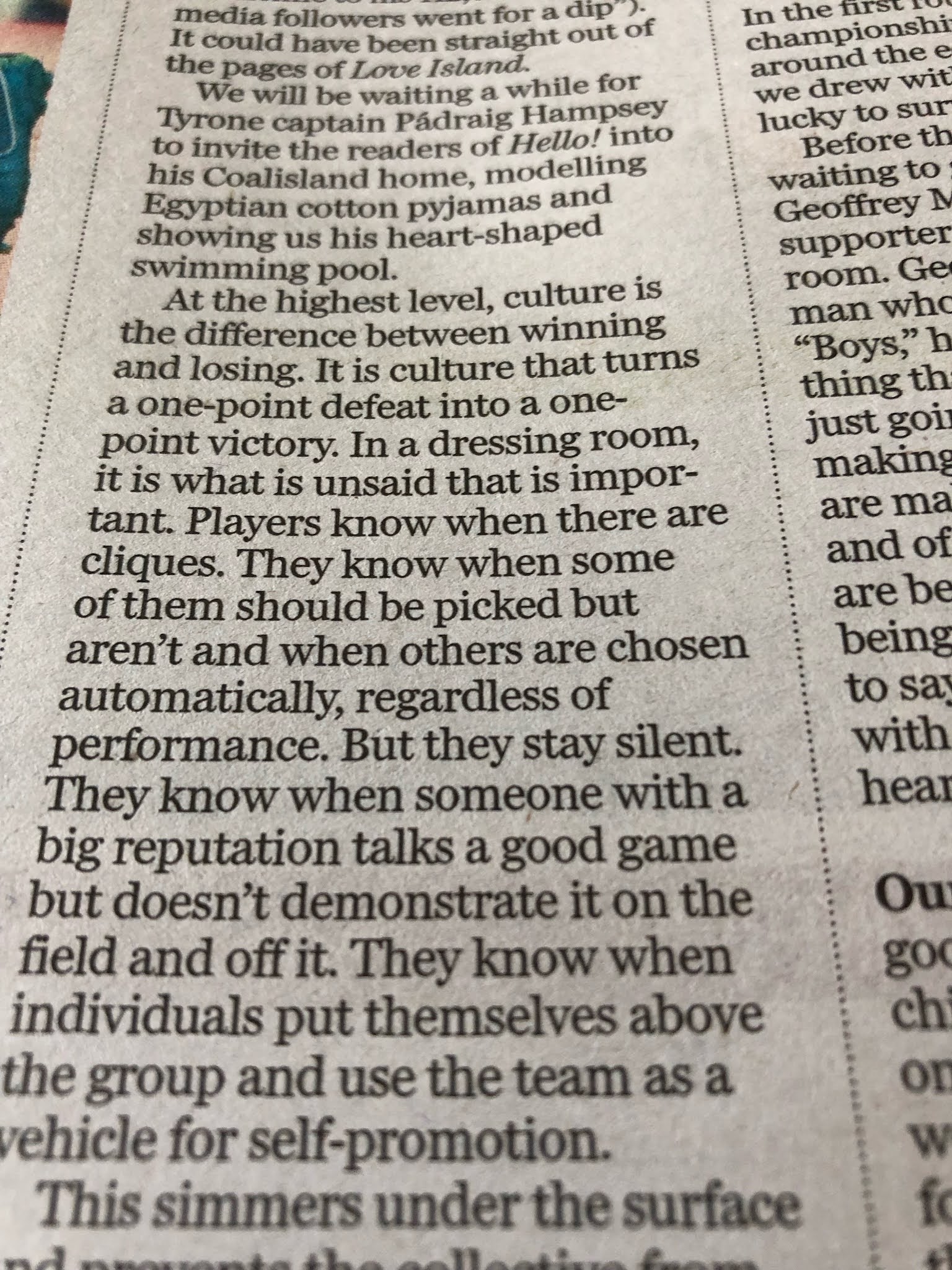
Although writing on GAA matters he came out with a brilliant nugget. He talked about what goes on in dressing rooms and said: ‘Players know when there are cliques’. Don’t we all know when there are cliques?
We all know cliques do so much damage to an organisation.
Weekend newspapers have reading in them for the week.
I find with anything I read using electronic media I’m far more tempted to skim read it, constantly scrolling down to see how long it is.
There can be a great joy in reading a hard copy newspaper. I’m inclined to think that is not the case with digital media. Then again, am I saying that because I am an old fuddy-duddy, who’s just growing older?
No, I don’t think so. And before a word is said about the environment, newspapers are recyclable and it’s a shame that there is not a single paper factory in the State.
I think I’ll hold off subscribing to the digital version.
Monday, September 13, 2021
Spending over €30m to examine wasting €8 million
The State set up a Commission of Investigation to examine the sale of building services group Sitserve to billionaire Denis O’Brien. The sale took place during the financial crisis.
Siteserve was heavily indebted to the Irish Bank Resolution Corporation at the time it was sold to the Denis O’Brien-owned Millington.
IBRC was made up of the two collapsed banks, Anglo Irish Bank and Irish Nationwide Building Society.
It was sold for €45 million in 2012. IBRC wrote off €119 of the €150 it was owed.
The report concludes that the State could have made an extra €8 million from the sale.
Taoiseach Micheál Martin has said the inquiry will cost in excess of €30 million. The Dáil has heard claims that the inquiry could cost €70 million.
Spending either €30 million or €70 million to investigate wasting €8 million sounds absurd.
Sunday, September 12, 2021
The West might well have been kinder to Mother Russia
On this day, September 12, 1990 the two German States and the Four Powers, the Soviet Union, United Kingdom, France and the United States signed in Moscow the Treaty of the Final Settlement with Respect to German Unification.
Significant that it was signed in Moscow.
Had the West been more magnanimous to the then government in Moscow might the world be a far safer and more secure place today? Most likely yes.
Was it not agreed in those days that Nato troops would not go east of the new Federal German frontier?
The West has not got clean hands when it comes to how it has teated Mother Russia.
Saturday, September 11, 2021
The strength to carry our cross
The Thinking Anew column in The Irish Times today.
Michael Commane
We don’t hear it too often these days but if someone says to me that I should offer up pain or suffering I immediately react with a sense of anger and annoyance. I keep asking myself – what is it all about?
Why must some people suffer so much?
Just last week a woman told me about her mother’s dementia. The woman was visiting her father in hospital, so naturally he too was concerned and perplexed about the condition of his wife.
At one stage in our conversation the woman mentioned that she felt guilty because she should have spotted the early signs of the disease and maybe she could have taken action earlier and that might have been of help to her mother. Most of all it was that sentiment that struck a chord with me.
There’s an old adage I so often heard as a child: ‘If all the ifs and buts made pots and pans there’d be no need for tinkers’. Traditionally travellers/tinsmiths were experts in repairing broken pots and pans.
Some years ago had I left the house two minutes later or earlier I would not have been knocked off my bicycle. All those ifs and buts in our lives ... simply put, there are no answers that make sense to us. Are there any answers to pain and suffering? The wife of a close friend of mine died of a brain tumour. She was far too young to die. We all have similar stories.
Are our lives made up of a succession of accidental happenings, the people we meet, the people we love, those who come together and bring new life into the world? From beginning to end it seems to be one continuous matter of accidental events.
In my five years working as a hospital chaplain I have seen first-hand the fragility of our lives. I am constantly amazed by how people cope with their illnesses. We humans are amazingly adaptable.
In tomorrow’s Gospel (Mark 8: 27 - 35) when Jesus asks his disciples who do people say he is, he tells them that God’s ways are not the ways of human thinking.
If they want to be his followers, they need to renounce themselves, take up their cross and follow him. “For anyone who wants to save his life will lose it.”
In recent days Eileen O’Riordan, mother of the late Dolores O’Riordan of Cranberries fame, has spoken on a number of media outlets about her talented and wonderful daughter, who died in 2018.
Last Monday would have been the singer’s 50th birthday. Eileen has spoken publicly of how her faith has kept her going in such difficult times. Listening to her I was back thinking of the fragility of our lives, the fact that we have no idea what might face us tomorrow.
Maybe because of the very fragility and the randomness of our lives I’m inclined to say that there must be more to it than what meets the eye.
Yes, I fall back on the faith of my parents and their parents before them and say, in belief, that we are destined in some way or other to be united with God.
I don’t understand suffering, I cannot account for the vagaries of human behaviour. But these days I keep saying to myself that there has to be more to our existence, that it does not end with simple full stop, like a sentence written on paper.
I also realise that it is folly – and a terrible form of arrogance to think that we are fully in control of the circumstances of our lives. Just look around and see the job that we can do. Yes, we humans can do extraordinary good but we can also inflict indescribable pain and suffering.
Of course it’s wrong to preach resignation to the poor and suffering, but in moments of great hardship and pain a cry out to God, invoking God’s name, might well give us a perspective on what our lives are about.
There is a line in the reading from Isaiah in tomorrow’s liturgy which goes: “The Lord is coming to my help”(Is 50:7). Christians believe that all our unanswered questions and dilemmas will be resolved in God’s providence.
In that context I accept that there is an all-seeing God, whose nature is to love the world, to love its creatures, to love me. In that context, I hope and pray that I will be able to carry my cross.
Friday, September 10, 2021
Darwin and Kant looked down their noses on smell
Charles Darwin believed that smell to be “of extremely slight service” to humans and Immanuel Kant regarded it as “most dispensable" of the senses.
It’s doubtful if people who have suffered from long Covid would be impressed with Darwin’s and Kant’s views on smell.
Thursday, September 9, 2021
Republic of Ireland population goes north
For the first time since 1851 the population of the 26 counties has exceeded five million.
According to CSO figures the population of the State stands at present at 5,011,500.
Wednesday, September 8, 2021
The twin evils of arrogance and entitlement
Fintan O’Toole writing about the politicians involved in the Merriongate scandal in his column in The Irish Times yesterday wrote:
The privileges of office have become entitlements. And entitled people, however smart, do stupid things. In the thin air of high political altitudes, they become light-headed with hauteur.
If cocaine is God’s way of telling you that you have too much money, the drug of arrogance is her way of telling everyone else that you've been in office too long.
Interesting words and they don’t exclusively apply to politicians.
Wides words too and apposite.
Tuesday, September 7, 2021
The Irish Independent worked the trick on the day
This week’s Mediahuis Irish regional newspapers’ column.
Michael Commane
It’s been a while since I managed to get out of Dublin.
I spent the last week of August in West Kerry. It’s the place I call my home. But that’s another story. I’m tempted to say I’m never sure where home is these days.
I had planned to come to Kerry in mid-August but work commitments and some pressing matters made that impossible so more or less on a whim I decided to break loose the last week of August.
And did I hit the jackpot. Every single day the sun shone and big time too. Most days I managed to get in two swims. The tides were such it meant a swim first thing in the morning and the last thing at night. It’s sad to see the days closing in but not much we can do about it.
I’ve been scratching my head and asking myself what’s better, village life or living in a town or city. I’m wondering are there any answers to anything.
Talking to a cousin of mine on the day that Tyrone beat Kerry I was reminded of a hilarious experience I had here in West Kerry in July 1974.
I was here on holidays with my parents two weeks after my priestly ordination. I enquired from a cousin what sort of a man the parish priest was as I intended asking him permission to say Mass in the local church.
My cousin, who is a wily sort of fellow, and was then too, asked me if I knew anything about GAA. He went on to explain to me that the parish priest was a GAA fanatic and if I could let him know I was into the GAA it would be a great line of introduction. He also told me that the parish could be at times off-putting, maybe a little abrupt.
So off I went armed with a certain amount of information. But the problem was that I knew zilch about the GAA and certainly did not know the name of one single player on the Kerry team of that year.
I arrived at the pp’s house on a Monday morning. The door was open but I think I knocked on it. He arrived at the door.
I explained who I was and he invited me to step inside. I was nervous. We exchanged a few words. There on the hall table I saw the Irish Independent.
Within seconds I had a brilliant introduction. I asked the parish priest if he had read John D Hickey’s report of the Sunday game. He smiled and said he had. I had no idea who had been playing. But what I did know was that John D Hickey had reported on the big game on Sunday for the Irish Independent. John D Hickey was my uncle, my mother’s brother.
The parish priest launched forth on the Sunday game, getting into details about which I had not got a clue. I tried to look interested and knowledgeable. I was nervous he’d ask me a question. At the first opportunity I asked him would it be ok if I celebrated Mass in the church.
Whatever way he responded, I got the impression it would have been ok had I celebrated Mass standing on my head.
He continued talking about the game and my uncle’s analysis of it.
And all the time I kept up the pretence that I knew what he was talking about. Every time I pass that former presbytery I get an urge to call and tell the present occupants the story of me and the parish priest.
Monday, September 6, 2021
‘Players know when there are cliques'
These two pieces are from
Joe Brolly’s piece in the Sunday Independent Sport yesterday.If you happen to have a copy of the newspaper in your possession and have not read the full article, then make sure to read it. It comes highly recommended and of course the sentiments expressed do
not exclusively apply to football or sport.It is a clever piece of writing, maybe more subjectively said, this blogpost writer agrees with it and finds it pertinent and applicable to so many walks of life, secular and religious.
So often, isn’t the cliques that destroy so much good.
We all know when there are cliques. And they always do terrible damage to the body politic.
Sunday, September 5, 2021
A letter in reply to David McConnell
This letter was published in The
Irish Times yesterday.
Is it a convincing reply to David McConnell's piece?
Is it "ludicrous for the most ardent atheist to argue these values originated anywhere except Christianity”?
Saturday, September 4, 2021
It doesn’t make sense to blame secularism for world’s ills
The Right&Reason column in The Irish Times last Tuesday was written by David McConnell, honorary president of the Humanist Association of Ireland.
He concludes the piece with this thought:
"The way to dialogue is through mutual respect and understanding.
"A religion will not retain or regain respect in society by blaming all the ills of the world on secularism and humanism (or on other religions) or by claiming that religions have a special right to be heard."
Friday, September 3, 2021
Jimmy, The Provo and the Eye and Ear
I first met Jimmy Fitzsim0ns in the early 1990s when we were both living in Dublin’s north inner city. We became friends
Back then Jimmy was a strong supporter of the Provisional IRA. More accurately said, he was forever talking about them.
On one occasion I asked his mother, who had a stall on Moore Street, if Jimmy was in the IRA.
She replied: “Jasus, the Eye and Ear wouldn’t take him.” We laughed.
Mrs Fitzsimons has since died. She was a lady.
On Wednesday I bumped into Jimmy on Dominick Street. We were chatting, our usual banter. He began to tell me what he was doing for the rest of the day and then said: “I have to get gear for the Provo.” I was confused and did not understand what he was saying so I asked him to explain.
Right behind him was a pug style dog. It was Jimmy’s
The dog's name, The Provo.
Thursday, September 2, 2021
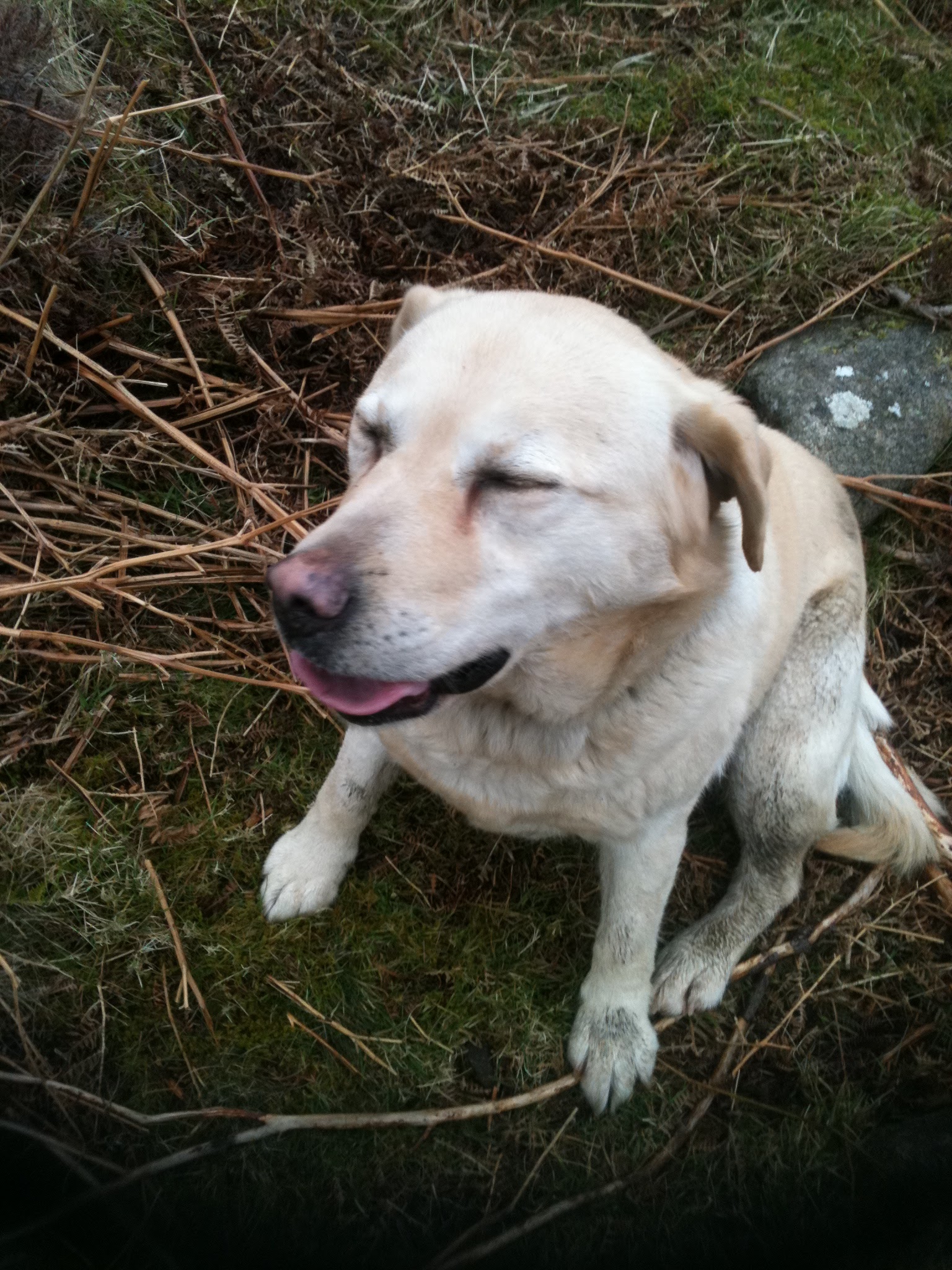
Tess, had been on many a mountain but loved her comfort
It may have been 2007, at least
sometime in that period, that I acquired Tess my Labrador.
She had been with a family where the couple split up and Tess was not quite abandoned but left somewhere in no-man’s land.
My previous dog had died and the woman of the house suggested Tess would be a good fit for me.
She turned out not just a perfect fit but an adorable friend.
She moved to Dublin with me. We climbed every mountain in Wicklow and Dublin and some in Kerry. We regularly swam in the Atlantic.
As she grew older, friends pointed out to me that it was not fair to leave her at home all day on her own while I was out at work.
Their wisdom prevailed and in 2016 Tess moved less than two kilometres to her new home, where she was spoiled beyond words.
Anytime I called to see her, even in her old age, she came to greet me. She well knew who I was.
On Monday I received this message from Bernadette:
"St Francis took Tess at 7.10 a.m this mirning. First time ever she barked and woke me at 3am. I came down & sat with her until she died. What a wonderful creature she was. Peter and myself are heartbroken. But glad she didn't suffer much.
Thank you for giving her to us."
Wednesday, September 1, 2021
Tuesday, August 31, 2021
The church is always in need of reform
This week’s mediahuis Irish regional newspapers’ column.
Michael Commane
Nelofer Pazira, an Irish based Afghan-Canadian journalist and film maker, wrote an opinion piece about Afghanistan in ‘The Irish Times’.
She quoted Bengali poet Rabindranath Tafgore, who said that the Mujahideen ‘spiritualised politics’. He argued they used religion to achieve political victory. Pazira adds that it was the Taliban who perfected the art of brutality through religion.
Pazira’s piece rang all sorts of bells in my ears.
During the Northern Ireland Troubles I spent many days and nights trying to explain to Germans that the violence in Northern Ireland was not caused by religion. I argued that it was a mix of injustice, incompetence, gerrymandering and wrongdoing.
I still say that today but in the intervening years I’m sure I’ve learned more about human behaviour and how religion becomes immersed in other areas of our lives.
I’ve experienced many positive aspects of religion. I have seen how faith and belief in God has nurtured the lives of people. I’ve also met remarkable priests, great people of God. I have been privileged to meet outstanding priests.
But I’ve also seen how religion can be abused. I’ve seen how easy it is for fanatics to use religion for their own purposes.
Just as extreme elements in other religions can misuse religion for their own ends, crookedness too, so it is with the Catholic Church.
Could it really be a mortal sin not to attend Mass on a Sunday? The expression ‘a holy day of obligation’ sounds greatly off-putting to me. I can still remember all the rules and regulations about the three-hour fast before receiving Holy Communion. Was God ‘up there’ with a stop watch? I doubt it. If I ate meat on a Friday was it really a mortal sin?
What exactly is a mortal sin? What do those words mean for people today? Has our theological vocabulary broken down?
It has always intrigued me how the hierarchical church seems so often to mismanage its affairs. I’ve seen crass behaviour by a small minority of priests. It has been a source of great mystery to me how these same men seem to know so much about God?
The church is always in need of reform but right now there really is a need for an open and honest debate between all Christians of good will.
The new Catholic archbishop of Dublin Dermot Farrell has set up a task force to begin an assessment of the needs of the people of the archdiocese. It’s a great idea. The chairperson is a priest. I’d much prefer to have seen someone who is not a member of the clergy appointed as chair.
Would that be too much to expect?
In an interview with Alan O’Keeffe in the 'Sunday Independent' last Sunday week Archbishop Dermot Farrell quoted philosopher Ludwig Wittgenstein who said to his Irish friend Maurice Drury:
"Only if you try to be helpful to other people will you in the end find your way to God.”
He also said that the housing and climate crises must be addressed with urgency nationally and globally.
That gives me hope.
Monday, August 30, 2021
IMF pays out $650 billion to developing countries
Last week the IMF - International Monetary Fund - distributed $650 billion to help poor countries pay down debt and withstand the costs of fighting Covid-19.
Sunday, August 29, 2021
Olaf Scholz heading for the top job in the city on the Spree
On Sunday, September 26 the Germans go to the polls to elect a new parliament, which will in turn elect a new chancellor.
This blog is predicting that the current federal finance minister, Olaf Scholz will succeed Angela Merkel.
Scholz is the SPD - Social Democratic Party of Germany - candidate for chancellor. He is a former mayor of Hamburg.
When Scholz was asked during the current campaign by a journalist why he was looking so grim despite growing election momentum for him and his SPD party he replied: “I am applying for the job of chancellor and not that of a circus director.”
Brilliant response.
Saturday, August 28, 2021
Martin Luther King’s I have a dream
On this day, August 28, 1963 the famous march on Washington for freedom and jobs. Martin Luther King Junior gave his famous I have a dream speech.
I still have a dream, a dream deeply rooted in the American dream - one day this nation will rise up and live up to its creed, “We hold these truths to be self evident: that all men are created equal.” I have a dream....
Below is the famous speech delivered by Martin Luther King at the Lincoln memorial on August 28, 1963.
Friday, August 27, 2021
China has 1,058 billionaires
In 2020 there were 1,058 billionaires in the People’s Republic of China compared to 696 in the US.
Approximately 600 million people in China live on a monthly salary of $154.
Thursday, August 26, 2021
Vladimir Putin on the dangers of foreign intervention
“I think a lot of politicians in the west are beginning to realise that you can’t impose your standards for political life and behaviour on other other countries and peoples, regardless of [their] ethnic and religious make-up .... and historical traditions.
“You have to give these peoples the right to determine their fate by themselves, however long it takes them to go down the path of democratisation"
Russian president Vladimir Putin.
The Russian president as a young man spent many years working east a KGB operative in Dresden in the former German Democratic Republic.
Wednesday, August 25, 2021
New New York governor has close links with west Kerry
New governor of New York Kathy Hochul has close links with west Kerry Her grandparents are from the Maharees in the parish of Castlegregory.
The new mayor was sworn in as New York's first female governor yesterday.
A Buffalo native, Hochul served as lieutenant governor since 2015.
She plans to launch her own bid for reelection next year.
Tuesday, August 24, 2021
The goal that brought a tear to my eye
This week’s Mediahuis Irish regional newspapers’ column
Michael Commane
I know little or nothing about most sports. In school I enjoyed athletics and table tennis. I ran on the school senior relay team and I won the odd game of table tennis. Over the years I have dabbled in other sports, did it for the fun of it and enjoyed it all.
I tuned in to the Cork Kilkenny hurling semi final and found myself shouting for Cork. Was that because Kilkenny has been at the top for such a long time? Probably. But I spent five years living in Cork. That may have had something to do with my shouting for Cork. And then there was the Dublin Mayo game.
Again I was cheering on the underdog.
Obviously that sort of support is total anathema to the experts, the fanatics, the purists, who sleep, eat and drink the sport.
But after the Mayo victory over Dublin I have been thinking about the world of sport and how people follow different teams. I found myself reading every word the Sunday Independent printed on the Mayo Dublin game. At this stage I even know enough to read Joe Brolly first as he might well give me a bit of a laugh.
There is an aside to the Mayo game. Last month I found a wallet, which contained a betting slip. It was a bet on Mayo to win the All-Ireland at 12/1 and the person had waged €50. I tracked down the owner and gave him his wallet, with all the contents, including the betting slip.
A work colleague is a supporter of Leeds. He’s a man I like and gradually I find myself keeping an eye out to see how Leeds are doing in the English Premiership.
Anytime I stop him on the corridor I’ll ask him how Leeds are doing. At this stage I even know the names of one or two of the players.
Some weeks ago I arrived home from a swim in the sea. The RTE One 6.01 News was almost over and just as I tuned in they were showing a clip of the Kerry Derry minor All-Ireland final. I was half watching until I heard the name Maurice O’Connell being mentioned. He was scoring a goal in the dying minutes of the game before they lost by a point. I was stuck to the floor and found myself shedding a tear.
Maurice O’Connell is from Castlegregory in West Kerry. I know him from the day he was born, I baptised him, I am great friends with his family. I have kicked ball with him in his garden. I have watched him over the years and seen first hand his love, dedication and enthusiasm in playing football. I just found watching him on the tele scoring a goal so emotional.
Some days later talking to his mother she was enthralled with what fun and the pure joy he and his teammates get out of kicking a simple ball and she also added how it keeps them out of all sorts of trouble. ‘All they need is a simple ball that costs a few bob. It really is amazing,’ she laughed.
Kerry meet Tyrone on Saturday. Maurice O’Connell has not yet made it to the senior team. But if he does, then I’ll be screaming like a lifelong supporter for Kerry to win.
I often hear people telling me I’m far too subjective. So much to do with our lives is subjective. And so much to do with sport certainly is.
Monday, August 23, 2021
The first day of the battle at Stalingrad
On this day, August 23, 1942 the Germans began their assault on Stalingrad, now Volgograd.
They were confident and convinced they would take the city on the Volga in two weeks.
Early the following February the Germans surrendered.
Hitler proclaimed that after Stalingrad's capture, its male citizens were to be killed and all women and children were to be deported because its population was "thoroughly communistic" and "especially dangerous”.
Confidence is a double edged sword. Seventy nine years ago today the ancestors of Mercedes, Krupp, BASF, Bayer, German Rail et al placed their complete confidence in the then leadership of Germany.
It was a misplaced confidence.
Archbishop quotes Wittgenstein admitting to problems
In an interview with Alan O’Keeffe in the 'Sunday Independent' yesterday Archbishop Dermot Farrell quoted philosopher Ludwig Wittgenstein who said to his Irish friend Maurice Drury:
"Only if you try to be helpful to other people will you in the end find your way to God.”
The Archbishop went on to say that we need to examine the quality of both our liturgies and preaching of the word of God.
He said that music in the liturgy is not just to entertain us - great music will always take us to the silence of the mystery from which it comes.
Archbishop Farrell said that he is about to publish a pastoral letter on climate change in the coming days.
He admitted that the housing and climate crises must be addressed with urgency nationally and globally.
Sunday, August 22, 2021
Taliban perfected the art of brutality through religion
Nelofer Pazira is an Irish based Afghan-Canadian journalist and film maker. In The Irish Times yesterday she wrote an opinion piece titled, ‘How long can the ‘rebranded' Taliban keep up appearances?'
In it she writes:
“It was the Mujahideen who ‘spiritualised politics’ in the words of Bengali poet Rabindranath Tafgore.
“They used religion to achieve political victory.
“But it was the Taliban who perfected the art of brutality through religion.
Saturday, August 21, 2021
An antidote to feeling useless - but not at all
This is a meme that is currently doing the rounds.
If you ever feel useless, remember it took 20 years, trillions of dollars and four US presidents to replace the Taliban with the Taliban.
- Dr Norman Finkelstein
But why is there no mention of the dead?
It could have been so clever, but not mentioning the dead it is grotesque.
Friday, August 20, 2021
One of the defeats of World War II was the defeat of men
Harald Jähner’s Aftermath is a gripping description of what life was like in Germany between 1945 and 1955.
The journalist Marta Hillers wrote in her diary in April 1945
"Deep down we women are experiencing a kind of collective disappointment. The Nazi world - ruled by men, glorifying the strong man - is beginning to crumble, and with it the ‘Man’.
"In earlier wars men could claim that the honour of killing and being killed for the fatherland was theirs and theirs alone.
"Today we women, too, have a share. That has transformed us, emboldened us.
"Among the many defeats at the end of this war is the defeat of the male sex."
Thursday, August 19, 2021
Empires behaving badly
On this day, August 19, 1953 the governments of the United States of America and the United Kingdom overturned the legally elected government of Mohammad Mosaddegh in Iran.
MI6 and the CIA, using immoral, illegal and brutal tactics reinstated the Shah Mohammad Reza Pahlavi to power in Iran.
Mosaddegh was a fine statesman, lawyer and parliamentarian. His administration introduced a range of social and political measures such as social security, land reforms and higher taxes, including the introduction of taxation of the rent on land.
But his government nationalised the Iranian oil industry. The British and Americans were having none of it.
Mosaddegh was imprisoned for three years, then put under house arrest until his death and was buried in his own home so as to prevent a political furor.
Have the British and American governments ever apologised for the terrible wrong they did to the Iranian people?
In 2013, the US government formally acknowledged its role in the coup, as a part of its foreign policy initiatives.
How many empires have put the boots of poor soldiers on the soil of Afghanistan?
Wednesday, August 18, 2021
No need to get sucked into stuff
It’s very easy to get sucked into stuff.
In the reality we live in, that’s shown to be the only possible reality, the only way of life, but that’s not true.
It’s just an ideology. That’s all it is.
Having studied literature and drama at the University of Roehampton Claire-Louise Bennett was soon disillusioned:
It was the first time I really saw proper wealth and I saw inequality and I started to feel that most people were being fobbed off, taken for a bit of a ride and sold a bit of a lie really; oh you just have to work hard and all the rest of it, what a crock of shit that is.
Claire-Louise Bennett is author of newly published Checkout 19, published by Jonathan Cape.
Tuesday, August 17, 2021
A lesson learned from the fall of the Berlin Wall
This week’s Mediahuis Irish regional newspapers’ column.
Michael Commane
It so happens that this year August 13 fell on a Friday. For those who are superstitious it’s a bad omen.
But another August 13 brought much bad news to many people.
On Sunday, August 13, 1961 the people of Berlin woke up to the devastating news that their city was being divided in two.
After World War II Germany was divided between the four victorious powers, the Soviet Union, the USA, Britain and France. The eastern part of Germany was under the control of the Russians. But Berlin, which was in the heart of eastern Germany came under the control of the four powers.
In 1949 when East Germany was set up as an independent State, East Berlin became its capital city.
From 1950 West Berlin was governed by the Berlin Senate and was politically and socially linked to West Germany but in law it was not part of West Germany, officially known as the Federal Republic of Germany.
Early on August 13, 1961 East German troops and police began erecting a 156-kilometre barbed wire fence cutting off West Berlin from East Berlin and East Germany.
The barbed wire was duly replaced over the years by a large cement wall dividing the city and dividing East from West Germany. Between that fateful Sunday in 1961 and 1989 the East German authorities spent massive sums of money fortifying and strengthening what they called the Anti-Fascist Protective Rampart but was called the Wall of Shame by West Berliners.
The East German authorities built the wall to stop the haemorrhage of people, especially highly qualified and technical people from moving from East to West. It is estimated that 19,000 people left East Germany for West Germany via West Berlin in June 1961.
Approximately three million people moved from East to West between 1948 and Sunday, August 13, 1961. It was obvious to the East German authorities the only way to stop the flow of people was to build a wall, making it physically impossible for them to exit the country.
I worked in West Berlin in the mid -1980s. Never once in my time living in the divided city did I think for one moment that the Berlin Wall would come down in my lifetime.
In those years of a divided city, West Berlin became a quaint place to live and it attracted interesting people, especially from West Germany. German men, who lived in West Berlin were not obliged to do military service.
The West Berlin authorities offered many incentives to attract people to the city. The city enclave in the heart of East Germany became a type of Mecca for artists and musicians and indeed refuseniks of all shapes and sizes.
Watching on television the Wall come down on Thursday, November 9, 1989 I made a solemn promise I would never again pay heed to anyone who tells me that something or other is impossible or can’t be done. That is of course, unless it defies the laws of gravity or other physical impossibilities.
And it’s important to note that not one life was lost in taking down that wall.
Subscribe to:
Posts (Atom)
Featured Post
Rural Ireland wants to deport foreign criminals
Eighty-five per cent of people in rural Ireland believe that foreign nationals convicted of crimes should be deported. There are approximat...
-
An interesting quote from Napoleon Bonaparte: “The honest man never doubts the existence of God’.
-
This is a worrying story. It’s written by Conor Pope and appeared in The Irish Times on Monday. It becomes ever more worrying how large org...
-
Former Dominican priest Tom Tom Brodie Brodie died in a nursing home in Galway yesterday. He had been ailing for some time. He was born in C...