Saturday, January 19, 2019

Tony O'Riordan SJ talks inspiring words on RTE Radio 1

On Thursday Jesuit priest Tony O'Riordan was on RTE 1's Sean O'Rourke programme.

He spoke about his work with the Jesuit Refugee Centre in South Sudan.

He is part of a team educating 500 teachers.

In the camps, which are under the control of the UNHCR, there are 60,000 school-aged children.

It's well worth listening to O'Riordan talk. It was aired at approximately 11.35 on Thursday.

It was interesting that he never mentioned words such as evangelisation, apostolate, church, God, secularism. Never once condemned anyone or anything and yet it was one of the finest pieces of Christianity to be heard all week.

Friday, January 18, 2019

Two important dates in Polish history

On this date, January 18, 1943 the Jews in the Warsaw Ghetto rose up against their German oppressors/murderers.

And on the same date two years later the Red Army liberated the Polish city of Cracow.

Thursday, January 17, 2019

Hello and goodbye

Shortly after 10pm last evening British Prime Minister Theresa May spoke outside 10 Downing Street about the Brexit dilemma.

It was a short few words calling on all parliamentarians to work for the good of the nation.

But it was odd that she never said hello or goodbye.

Her performance was strikingly abrupt and she said nothing new.

Wednesday, January 16, 2019

Wise words

The best way to avenge yourself is not to be like that.

Marcus Aurelius

Tuesday, January 15, 2019

Iarnród Éireann looking for loco drivers outside the company

This week's Independent News & Media Irish regional newspapers' column.

Michael Commane
For the first time in its history Irish Rail is advertising for locomotive drivers outside the company. Until now all its locomotive drivers were chosen from Irish Rail staff. There may have been occasions when the job positions were also open to Dublin Bus and Bus Éireann drivers.

So, when I saw that outsiders could apply I made further investigations.

I have to be honest, come out with my hands up and admit that my age maybe against me, though in the advertisement the only age specification is that the applicant has to be at least 20. There is no mention of an upper age limit and we are living in a non-ageist environment. Or are we?

I spent 60 minutes answering the first part of the procedure for the job. It is an online questionnaire and test.

The online application process closed on Monday January 14 and late applications will not be considered. So, if I was building up your hopes for a job as a locomotive driver, I’m afraid you will have to wait until the next time they are advertising for drivers.

Note that I use the words ‘locomotive driver’. No self-respecting railway driver would use the word train when the correct term is locomotive.

I never had a train set. We had a horrible teacher in first class who told us there was no such thing as Santa and that was the very year he was bringing me a train set. Santa never came that year.

But over the years I have made up for what Santa failed to bring me.

In my early 30s I was teaching in Newbridge College when Irish Rail was replacing old timber sleepers with cement ones and at the same time they were putting down continuous welded rail between Newbridge and Sallins, which meant the clickety-click of rail travel would be history.

During that time, I spent many hours walking stretches of the track while crews were out modernising the railway.

Later living in Germany I experienced the introduction of their InterCity Express (ICE) trains, which are now travelling on some tracks at 320 km/h.

After German reunification German Railway (Deutsche Bahn), owned by the German State, began an enormous job of rebuilding the old broken down railway system that existed in the former East Germany. Today every German city from Aachen in the west to Dresden in the East, from Flensburg in the north to Garmisch Partenkirchen in the south is connected to the ICE system, which offers the most superlative pleasure in travel.

What the Germans have done with railway infrastructure in and around Berlin in the last 29 years is mesmerising.

Irish Rail have also made giant steps in the same period.

The fleet has been modernised. The signalling system upgraded.

There is an hourly Dublin Cork service, a two-hourly service between Tralee and Dublin. And there are excellent schedules between Dublin and Galway, Sligo, Limerick, Waterford, Belfast. And all these routes are served by modern rolling stock. Indeed, WiFi is now available for free on all Irish Rail InterCity services. Guess what, German Rail charges for the use of the internet.
Gosh, I’d love to be a locomotive driver.

With the first hints of the days getting longer and prospects of spring in sight the thought of guiding a train through the Irish countryside is pure bliss.

We need to cherish our railway.

Nearly forgot to mention I passed the first hurdle and have been invited to take the next test.

Monday, January 14, 2019

'Time doesn't heal'

Wise words from Edith Eger in The Choice.

Time doesn't heal. It's what you do with the time.

Healing is possible when we choose to take responsibility, when we choose to take risks, and finally, when we choose to release the wound, to let go of the past or the grief.

Sunday, January 13, 2019

A shore that is sure proof how we do things in Dublin

And if we have heavy rain or snow can this roadside shore help?

No.

The upkeep of the shore on Orwell Road  is the responsibility of Dublin City Council.

So often it's the little things that give us away.


Saturday, January 12, 2019

New film by von Donnersmarck

Florian Henckel  von Donnersmarck's new film 'Never Look Away' is not to be missed.

In many aspects it complements 'The Lives of Others', also  a von Donnersmarck film.

In an interview on CNN yesterday von Donnersmarck said that art can be a weapon against extremism.
.
.


A special day in Russian history

On this day, January 12, 1945 the Red Army began the Vistula/Oder offensive, the final attack against Germany. Soviet forces outnumbered the German Army 11 to one.

Zhukov's troops travelled 500 kilometres in 14 days.

Thursday, January 10, 2019

Wednesday, January 9, 2019

TV Trump tries to scare people

Guardian's Richard Wolffe casts a cold eye on last night's Trump television performance.


Belligerent words about keeping people out

Guess who said this.

I am the greatest builder of fortifications of all time.

It sounds familiar, sounds like something a current world leader might say.

It was said by Adolf Hitler as the Germans built their Atlantic fortifications against an imminent allied invasion.

Everything about their wall-building proved a failure. And it certainly did not stop the allied invasion.

Tuesday, January 8, 2019

Edith Eger's 'The Choice' a book not to be missed

This week's Indepenent News & Media Irish regional newspapers' column

Michael Commane

Before Christmas I met a friend for lunch. He usually arrives with a book for me but on this occasion he had no book in hand but strongly recommended I read 'The Choice' by Edith Eger.


I had vaguely heard about the book some time back. The author may have been on 'The Late Late Show' and I'm sure Ryan Tubridy mentioned the book on his radio slot.

By coincidence a work colleague also mentioned the book and was enthusiastic about it and suggested I read it.

'The Choice' does exactly what it says on the tin. It's about making our own personal choices in the here and now, living in the present, using the wealth of knowledge and wisdom we have gained during our lives.

Edith Eger was a 16-year-old girl, living in Hungary in the warmth and love of her gifted family. It was 1944 when they were brutally removed from their home and shipped in a cattle train to the Auschwitz death camp.

On her arrival she and her sister Magda were separated from their parents, who were sent off in another line, which ended in the gas chamber.

Edith and Magda spent a year at Auschwitz. Edith was forced to dance for Mengele, the doctor of death. It was Mengele who decided the fate of many of the people who entered through the gates of Auschwitz.

Edith and Magda with the help of luck and their tenacity to stay alive survived the hell of Auschwitz and went on to live healthy and happy lives in the United States. Of course their lives were not trouble-free.

But the book is an account of how Edith Eger made her life-decisions and how much of her decision-making was partly formed by her experiences at Auschwitz and her subsequent forced march to Gunskirchen.

She says that the worst moments in our lives, the moments that set us spinning with ugly desires, that threaten to unglue us with the sheer impossibility of the pain we must endure, are in fact moments that bring us to understand our worth. It's as if we become aware of ourselves as a bridge between all that's been and all that will be.

She went on to become an eminent psychologist in the United States. Her terrible suffering at the hands of the Germans gave her great empathy when dealing with her suffering patients.

In Auschwitz the stakes were life or death and the choice was never hers to make. But even in that hell she could choose how she responded. She could choose what she had in her mind.

Eger constantly stresses that while we can never erase the past, we are free to accept who we are and move on.

It was astonishing to read that when Auschwitz was liberated and the gates thrown open there were prisoners who went through the gates but then returned back to the camp.

Of course there are those who live in the present and get on with their lives but I'm all too aware many of us hark for the past and have unreal hopes for the future, always edgy about living in the present and making the best of it.

Eger tells us we can't change the past but we can change how we live now.

So much of our lives are based on accident, the flip of a coin. Edith Eger's 'The Choice' is an inspiring work that opens the reader's eyes to the power of the human spirit.

Monday, January 7, 2019

How leaders allow little officials to be cruel

This is a brilliant article that appears in today's Guardian.

Guardian columnist, Emma Brockes captures almost perfectly the mood in that room, the horrible nasty behaviour of the officials, their sarcasm, the fear of the Hispanic group of men.

But one would have to experience it before she/he could really understand what's happening in the world right in front of our eyes.

And this hatred is all the time being egged on by populist right-wing leaders.

These officials have suddenly been given an importance or significance that is allowing them to behave in such a manner.


Elizabeth Warren to run for the White House

It's looking ever more likely that US Democrat senator Elizabeth Warren will run for the presidency in 2020.

Te 69-year-old lawyer is a strong critic of big banks and unregulated capitalism.

She was born in Oklahoma and is the senior senator from Massachusetts.

Warren has native American ancestry.

Sunday, January 6, 2019

'Clerical and lay'

This surely has to be an extraordinary death notice.

 It must be a caricature of itself.

Note how clerical and lay are spelt, upper case c, lower case l. 

Funny, if it were not so tragic and real.

And it says so much about where the Irish Catholic Church is right now and where it is heading.

The death notice as it appeard in rip.ie and Irish newspapers:

Greenan O.P, Fr Lambert (Larry) (Ireland, Rome and Alabama), who died 29th November 2018 in his 102nd year in Birmingham, Alabama, where his Funeral Mass and Burial took place on 5th December 2018; mourned by his sister-in-law Jean, nieces, nephews and their families, relatives, Dominican confreres, Sister Servants of the Eternal Word (Birmingham, Al) and a wide circle of friends both Clerical and lay.

May he rest in peace.

A Memorial Mass will be celebrated in St. Saviour’s Dominican Church, Dominick Street, Dublin 1 on Sunday coming, 6th January at 11:30am.

Saturday, January 5, 2019

The coming of the Magi

The 'Thinking Anew' column in The Irish Times today.

Michael Commane
Former Irish ambassador to the EU, Britain and Italy Bobby McDonagh wrote a piece titled 'Christian harmony can coexist with modern beliefs' in this newspaper last week.

And the article does exactly what it says on the tin.

McDonagh recalls how he learned at school that there is no contradiction between Christian faith and philosophy or science or literature. 

To back up his observation he is reminded of the Raphael painting, which was commission by Pope Julius II for one of the rooms beside the Sistine Chapel. Raphael's 'The School of Athens' McDonagh says: 'captures perfectly the harmony between spiritual and worldly wisdom'.

But maybe the central theme of the former diplomat's article, it certainly was the catalyst that inspired the writing, was the recalling of the life and times of a great teacher he had at school.

He writes in glowing terms of his former teacher Jesuit priest Paul Andrews, who died on November 27.

Although Paul Andrews had left the school 47 years ago more than a third of McDonagh's classmates attended the funeral Mass.

McDonagh writes: "Sometimes it seems important for each of us to find a moment to remember a life which has been directed neither at fame nor at fortune, to acknowledge achievements which require no validation from tabloids or treasuries. We all know people who lived such lives. For me, Paul was one of them."

It's abundantly clear that Fr Paul Andrews was a brilliant teacher, who left an indelible mark on many people, including Bobby McDonagh.

Paul Andrews was a gifted man, who had the ability to see, speak and think about God in the environment in which he lived. He made God possible to many people, to those he accompanied, to those he taught and to those who read his works.

Tomorrow the Christian churches celebrate the great feast of the Epiphany. It's the feast that celebrates, the making present, the manifestation, the blossoming of the kingdom of God. Three wise men make known to the world the reality, the fact that this infant Jesus is the Son of God.

In tomorrow's Gospel Matthew recounts for his readers how the Wise Men were directed by means of a star to Bethlehem. In that same Gospel we learn of the tension between the worldly power of King Herod and the Wise Men, who manage to avoid the dangers that King Herod is plotting.

This Christmas I have encountered so many views of life and reality. I have sat down and listened to people who do not believe in God. 

I have experienced a church packed to the rafters. I have observed a brand of right-wing Catholicism that I can no longer abide and then up pops the feast of the Epiphany and the article by Bobby McDonagh.

McDonagh's article, at least for me, is a shining light. In so many ways it's the coming of the Magi, the wise men, who direct me to the greatness of God.

Obviously, Paul Andrews, in his own quiet, intelligent and charitable way sowed a seed in his students, a seed that helped many of them to go in search of God.

There is little or no point in bemoaning the world, indeed, so often it can be counter-productive and even a giveaway that we are placing all authority and power in ourselves rather than trusting in the greatness of God.

Tomorrow's feast might help all of us to be guided by a shining light. And don't we all encounter people who inspire and impress us with their kindness and goodness. They get on with it, irrespective of the clamour and noise about them. They don't seek headlines. And they live in the present in awe of the world about them.

Bobby McDonagh paints a picture of a teacher and priest who was obviously always in search of wisdom and intent on passing it on to others.

Surely his was the living out in everyday life of the feast of the Epiphany.

It's also worth noting that the Epiphany celebration is the setting of James Joyce's 'The Dead'.

Joyce was educated by the Jesuits and Paul Andrews played a significant role in rehabilitating Joyce within the Jesuit community in the 1950s. As Fr Bruce Bradley SJ said at Paul's funeral Mass: "Paul was quite prepared to break the disapproving silence and begin the process of setting the record (on Joyce) straight at last."

Another example of following a bright star, when it may not have been the popular action to take.

Friday, January 4, 2019

Another step in our carbon footprint

And early sighting, even if in the dark.


Words, their meaning and usage

On RTE Radio 1's Drivetime today NTA's CEO Anne Graham said: "... putting in place new fleet."

And during the interview she kept talking about 'new fleet', when she meant adding vehicles to the various public transport fleets.

It all sounded odd but dictionary definition of the word fleet is ambiguous

Words are indeed funny things.

The front page

The front page of the Irish Dominican website, www.dominicans.ie.


The content on the front page:


This week in the Light of Truth Fr. Luuk OP literals makes a flying visit to the Radio Maria studio to discuss the Gospel Passages relevant to the end of Advent and the Christmas season. The program is broadcasted live on Radio Maria Ireland from 4-5pm each Thursday. The Podcast follows but generally with a small delay. […]

Herzog Bring Centre still closed

There is a notice on the door of Herzog Park Bring Centre in Rathgar, Dublin  informing the public that it will be closed for renovations from Monday August 13, reopening in October 2018.

The bring bank is still closed and not a word of information to the public about the delay in reopening.

This is not how people should be treated.

And as it is a facility to support a cleaner environment it makes a statement about Dublin City Council's real interest in the environment.

Or does it?

So often it's the little things that say so much about us.


Thursday, January 3, 2019

Trump's notions on being a general

"I think I would have been a good general, but who knows."

One of the many comments made by President Donald Trump in Washington yesterday.

In a wide-ranging Q&A President Trump referred to how the Soviet Union engagement in Afghanistan bankrupetd the USSR. He spoke about the high wall around the Vatican and the library India has built in Afghanistan.

He told us how he spent Christmas alone in the White House looking out at soldiers with guns on the lawn. He never before saw so many submachine guns.

It was a fabulous 60 minutes of television.

Most noticeable was to watch the all-men platoon who sat by and listened to what he was saying.


Tuesday, January 1, 2019

In search of wonder

This week's Independent News & Media Irish regional newspapers' column.

Michael Commane
An article in 'The New Yorker' magazine caught my attention over Christmas.

Award winning journalist Louis Menard wrote a piece about whether or not Einstein believed in God.

It begins about Einstein's so-called God letter, which was sold by auction in Christie's in New York in early December for $2.9 million. A short 10 years earlier the letter made $404,000 at a British auction house. Not a bad return on an investment. And does it add weight to the generally held view that there's money in religion?

At the end of 'The New Yorker' article Menard argues that Einstein is saying in the letter that it doesn't matter what our religious or philosophical commitments are. The only thing that matters is how we treat one another. Menard quips that he doesn't think it takes a genius to figure that out and goes on to say: 'But it's nice that one did'.

In churches, that throughout the year are sparsely attended, there was standing room only for Christmas Mass. In one Mass that I celebrated I was told there were 800 people in attendance. That's a lot of people and they had come to church to pray and celebrate the feast that was in it. 

Maybe there were some there for other reasons. So be it. We were of course celebrating the Christian belief that Jesus Christ becomes man. Isn't that what Christmas is about? Or at least it's the original idea why we make such a big occasion of the last days of December. 

At all the Masses over Christmas the Gospel stories recounted the birth of Christ. We read how Mary was told not to be afraid, how his name means 'God is with us' and that 'the Word was with God and the Word was God'.

Certainly a lot of food for thought in all the words and ideas that were spoken in churches over the Christmas.

Words are fascinating. Their use, the meaning, the tone in which we say something is all part of the cocktail that gives expression to what we say, or at least what we are trying to say. So often in our daily exchange of ideas we can be misunderstood. Imagine what it must be like when we try to say something about God? Surely it must be all-too-easy to fall into saying words and expressing ideas about God that are ridiculously meaningless.

I keep saying to myself anytime we ever try to say a word or indeed anything about God we need to be extremely careful.

As the German Army pillaged, burned and raped its way across Europe in World War II every soldier had inscribed on his belt 'God is with us'. Can it get more absurd than that?

While all words are fascinating and involve elements or aspects of nuance and interpretation, words about God are super-fascinating.

Yes, it can be difficult to say anything about God, God's name is extraordinary, that God becomes man is extraordinary.

But aren't many aspects of our lives extrordinary, from birth to death.

People who filled our churches this Christmas gave me a glimpse of our search for the wonder, the extraordinariness of our lives and that includes our search for God.

Maybe there is the temptation to be far too filled with our own importance, our own certainty, to miss the wonder of all creation in front of our eyes, including the existence of God.

There can be something exciting and exhilarating in our lifelong search for God. 

Happy new year to all readers

As is now customary, the Germans celebrate the new year with special events at Berlin's Brandenburg Gate.

As the clocks struck 00.00 the choirs  on the Fan Mile sang out Beethoven's Ode to Joy, the anthem of the European Union.

A far cry from a city which on January 1, 1934 made a law for the prevention of genetically diseased offspring. In other words, all such children were to be aborted.

Happy new year to all readers of this blog and may 2019 be kind to you.

Monday, December 31, 2018

Changing times indeed

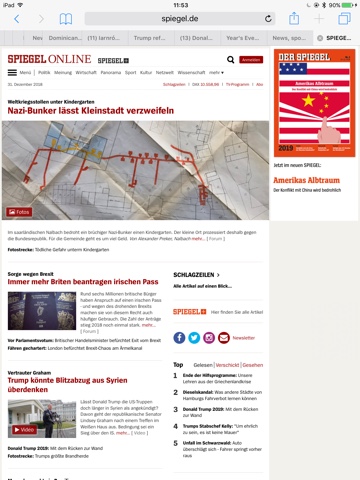
This on the front page of the digital version of today's Der Spiegel.

The piece is about English people applying for Irish passports.


On the cheap with Irish Rail from Waterford to Kildare

An interesting glitch in Irish Rail's fare structure.

The single flexible rail fare from Waterford to Limerick Junction is €5.29. The single fare from Waterford to Kildare is €14.49.

Irish Rail has two daily direct service from Waterford to Limerick Junction.

You may travel on the direct service at 07.20 to Limerick Junction but you may also travel on the 07.50 Dublin service, changing at Kildare.

The single flexible fare to Kildare to €14.49. Which seems to imply that with a little rail knowledge a passenger can travel to Kildare for €5.29.

Sunday, December 30, 2018

The USSR

On this date, December 30, 1922 the Union of Soviet Socialist Republics was formed.

Saturday, December 29, 2018

The present

The only place where we can exercise our freedom of choice is in the present.

Edith Eger in The Choice.

Featured Post

The ubiquitous mobile phone can be enemy number one

Seen in Dublin's Rathmines yesterday; a Garda car being driven by an officer, while using his mobile phone.  Some metres behind the Gard...