Friday, November 7, 2014

Pope Francis on gossip in religious congregations

Pope Francis on the gossip that goes on in  religious congegrations.

This man is so on the ball. He might be a Jesuit but he seems to have an insight into the nonsense that goes on within religious communities.

How the phones jump with gossip. And how so much of it is nasty. And then all the anonymous comment.

Religious orders and communities must combat "the terrorism of gossip," which is even worse than an occasional physical confrontation, said Pope Francis, a former Jesuit provincial in Argentina.
Meeting today with Italy's superiors of men's orders, which combined have a total of nearly 19,000 members, the pope said the way members of religious orders live should attract people to Christ and the church, and should be a model for other Catholics of creating harmony among a varied group of people thrown together by a common call.

"Please," he told the superiors, "don't let the terrorism of gossip exist among you. Throw it out. Let there be fraternity. And if you have something against your brother, tell him to his face. Sometimes it might end in fisticuffs," he said, causing the superiors to laugh. "That's not a problem. It's always better than the terrorism of gossip."

Congratulations to BBC Radio on a great series

BBC Radio 4's 'Germany: Memories of a Nation' concluded today. The series lasted six weeks.

It can be heard on the BBC player and the podcast will be available for 12 months.

The series was presented by Neil MacGregor, Director of the British Museum.

It has been a spectacular insight into Germany, past and present. And if anyone wants to learn anything about the soul and life of modern-day Germany and what made it so, then this series is a must.

Obviously the BBC planned the programme to end on the weekend, which is the 25th anniversary of the fall of the Berlin Wall. Today's episode concentrated on the Reichstag; its association with the unification of Germany, the Weimar Republic, the Nazis, the Red Army, German reunification and today's Federal Republic.

Written on the front of the Reichstag is 'Dem deutschen Volk'. Neil MacGregor translated it as 'For the German People'. Surely it means 'To the German People'.

Thank you BBC.

Thursday, November 6, 2014

Free sheet 'Alive' has quirky views on past and present

This month the freesheet 'Alive' attempts to change history.

On Page 15 there is a biography of St Oliver Plunkett.

St Oliver Plunkett was born in 1625 and died in 1681. The freesheet 'Alive' has the saint living in a different century.

Also in the November issue is an article 'explaining the absence of global warming'.

Another piece has the headline: 'Understanding the gay agenda'.

In the 'Editor's Jottings there is comment supporting Katie Hopkins and criticism of the Late Late audience, whom the editor claims were hostile towards her.

Is the editor aware that Katie Hopkins is a divorced woman? In that same piece he writes: "a woman may abandon her husband....."

At least, all most confusing. Inaccurate too.

Wednesday, November 5, 2014

A splintering church?

The piece below is from the National Catholic Reporter.

Divisions within the Irish Catholic Church can seem at times enormous. Members of religious congregations might well share nothing in common with one another. Is there really a common 'theology' that is shared and lived by religious congregations? Or is it just an amlgam of people who happen to find themselves where they are?

"Many conservative Catholics have long viewed Pope Francis with suspicion thanks to his effort to shift the church's focus away from a culture war agenda and toward a more welcoming approach and a greater emphasis on serving the poor.
But last month's controversial Vatican summit on the modern family, with the push by Francis and his allies to translate that inclusive view into concrete policies on gays and divorced and remarried Catholics, for example, seems to have marked a tipping point, with some on the right raising the specter of a schism -- a formal split that is viewed as the "nuclear option" for dissenters.
New York Times columnist Ross Douthat, a Catholic and a conservative, crystallized the peril in an Oct. 25 column warning the pope not to "break the church" to promote his goals, saying that if Francis continues to alienate conservative Catholics, it could lead to "a real schism."

Douthat had raised the possibility of "an outright schism" earlier this year, as well, and his warnings have been echoed by a number of other church leaders and commentators. The anxiety on the righthas also drawn increasing media speculation about the possibility of conservatives splintering off."

Tuesday, November 4, 2014

Berlin 25 years ago

Twenty five years ago today in the middle of East Berlin tens of thousands called for democracy and freedom in the GDR.

Among those who addressed the crowd were writers Christa Wolf and Stefan Heym. So too did Jens Reich and Gregor Gysi speak. But also on the podium that day was Markus Wolf from State Security. He was jeered off the platform. Politburo member Gunter Schabowski, who is the person, who seemingly accidentally, gave the green light for the opening of the Wall, also tried to speak at the meeting but he was shouted down.

After the demonstration the crowd dispersed peacefully and there was no talk of bringing down the Wall.

Five days later the Berlin Wall was breached.

It's ironic that on the 25th anniversary of the fall of the Wall there will be no trains running in Germany. German DB locomotive drivers are due to begin a 100 hour strike early on Thursday morning.

Germany's longest ever rail strike begins tomorrow

This week Germany will see its longest railstrike in the history of the Federal Republic.

All cargo traffic will stop at 15.00 tomorrow and then on Thursday at 02.00 all passenger trains will come to a standstill.

Regional, InterCity and S-Bahn operated by DB Deutsche Bahn/German Rail will be affected.

Trains will roll again on Monday from 04.00.


Rich and poor

The 85 richest people in the world own the same wealth as the 3.5 billion poorest people.

Eighty five people own what half the world's population possesses.

Monday, November 3, 2014

Jon Snow and the poppy

News presenter Jon Snow has refused to bow to viewer demands for him to wear a poppy, branding it ‘poppy fascism’. 

The art of politics?

"The label Independent is what gets us elected. Apart from being against the government, you don't explain in detail what you stand for because if you do you start losing votes."

A quote from an Independent TD.

Tempus fugit

It's now 'custom and practice' that this blog republishes an appreciation of John O'Gorman. John died on November 3, 2002, the feast day of St Martin dePorres. The appreciation below appeared in the Irish Times in the days after his sudden and untimely death.

John had no time at all for humbug and the clerical version of it pained him greatly. But he also had the wonderful ability at laughing at it all.

What at all would he have to say about the 'Constitutional Six'?


JOHN James O’Gorman was born in Blarney Street, Cork in 1945 and attended the North Monastery Christian Brothers School. He was one of their brilliant young men, obtaining a scholarship to UCC. But instead of going on to university he joined the Dominican Order in September 1962. He was professed the following year and ordained a priest in 1969.

John O’Gorman stood out as a shining light. Most of all he was a man of absolute integrity, but he was also endowed with brilliant intelligence. After priestly ordination he studied postgraduate theology in Rome and remained at the Irish Dominican community in San Clemente as bursar.

He spoke Italian like a Roman – or so said his neighbours on the Via Labicana. But he was not happy with Rome and the Roman scene. His first love was always science and mathematics. He began postgraduate work in maths while still in Rome. Father J.M. Heuston, a brother of John Heuston of 1916 fame, himself a fine mathematician, admitted that he had never before met someone with such mathematical talent. John came home to Ireland in 1976, moved to the Dominican Community at Newbridge and did his H.Dip at Maynooth. Without any formal degree in mathematics, he blazed a trail of brilliance through Newbridge College. Students seeming destined to produce average turned in spectacular performances.

By the time of his last year at the school, there were two streams in sixth year doing Higher Level Maths in the Leaving Cert. But John was also there for the not-so-clever. Anyone who sat at his feet in Newbridge will remember him as a brilliant and fair teacher. John was endowed with both a practical and speculative intelligence.

In the early 1980s he began to develop an interest in Computer Science and did a Ph.D, in computing at the University of Limerick. This led to a career in lecturing at the college, a job he greatly loved. He is the author of two books on computing and was in the process of publishing a third.

He was meticulous in everything he did. While mathematics and teaching were his first love there were other sides to this faithful son of St Dominick. He walked every by-road of Ireland, climbed to the top of every mountain and had a knowledge of roads, rivers and mountains that was simply breathtaking.

John also took his theology seriously, had a profound knowledge of the Bible, and was familiar with modern theological thinking. But he was never at home with his priesthood. In the mid-1980s he requested permission to resign from priesthood while remaining a Dominican. The Order granted his request.

Most of all John was a dear friend, someone who was always there to give the best of advice and help. He had absolutely no time for show or pretension and lived the simplest of lives. He never lost his Blarney Street accent. He carried his intelligence easily and never used it as a tool to lord it over anyone.

Above all, any signs of obfuscation annoyed him intensely. He had little time for people in authority who attempted to take short-cuts and he had no mercy for Dominican superiors whom he felt were not living up to their responsibility. He was a member of the provincial council of the Irish Dominicans and took his responsibility very seriously.

He was a true democrat, moulded by the constitutions of the Order, so when he felt superiors or communities were lack-lustre living out their calling to St Dominic, he had no hesitation in letting people know his views. He was in some ways a private man but was always there for his friends and he would go to any distance to help and support.

John was a physically fit man who could walk up to 20 miles a day. He took good care of himself. Yet he died in his room in the Dominican Community in Limerick on the evening of Sunday, November 3rd of a massive heart attack.

He is survived by his brother Andrew, sister-in-law Emer, niece Fiona, nephews Rory and Mark, and his Dominican brothers. I have lost a dear friend. May he rest in peace.
Michael Commane

Sunday, November 2, 2014

Metering water

Surely anyone interested in the environment sees the value in metering water.

Saturday, November 1, 2014

God is no magician - Francis

"Evolution of nature is not inconsistent witht he notion of creation because evoltution presupposes the creation of beings which evolve.

"When we read the creation story in Genesis we run the risk of imagining that God was a magician, with a magic wand which is able to do everything."

Pope Francis.

It's so easy and indeed, lazy to see God as a magician.

Friday, October 31, 2014

Dominican communities and that 'constitutional' six

Below is a comment from a Dominican in response to what Fr John Harris said at a public meeting in Drogheda.

Fr Harris' comments were posted on this blog on Monday, October 13.

"What a deception to claim that Dominicans can only function in sixes. When I arrived at a priory there were seven in residence and five were idle."

Thursday, October 30, 2014

God's greeting

"A mild morning, thank God"

The greeting of a workman directing traffic in and out of a building site at 07.10 today on Orwell Road.

Wednesday, October 29, 2014

Priests everywhere

The Irish Catholic dated Thursday, October 30 features over 100 pictures of clerics.

Pravda or Neues Deutschland were not even as bizarre or brazen as that.

Tuesday, October 28, 2014

The never-ending battle between good and evil

On this the feast of Saints Simon and Jude the Gospel reading is on the choosing of the 12 apostles.

Surely it's worth noting that even in a small group of 12 there is one dodgy character and someone who is picked by Jesus.

The constant stuggle between good and evil. Are we ever free of it?

Monday, October 27, 2014

Bradlee of Watergate fame

Ben Bradlee died on October 20. He presided over the Washington Post's reporting of the break-in at the Watergate building in 1972 that led to the fall of President Nixon.

Bradlee: "No matter how many spin doctors were provided, no matter how many sides of how many arguements, from Watergate on I started looking for the truth after hearing the official version of a truth."

In a memoir he wrote that the only prescription he had for the practice of journalism was a simple one:

"Put out the best, most honest newspaper you can today. And put out a better one the next day."

Sunday, October 26, 2014

Dublin Mean Time

The piece below is from today's digital Irish Times. Interesting.
England’s “800 years of oppression” in Ireland can be officially extended – by 25 minutes. 
Along with Trevelyan’s corn, it turns out they also “stole” Irish time. 
In 1916, months after the Easter Rising, the House of Commons in London introduced Greenwich Mean Time in Ireland and abolished Dublin Mean Time, which was 25 minutes behind. 
As a consequence, when British clocks went back an hour for winter 1916 at 2am on Sunday, October 1st, Irish clocks only went back by 35 minutes to synchronise time in both countries. 
The Irish people did not only lose 25 minutes of the extra hour in bed, the change was made permanent and prompted opposition from farmers, politicians, local councils and various business groups. 
However, it did get support from The Irish Times of the day.
Countess Markievicz, one of the rebel leaders in the 1916 Rising and the leading woman in the Irish struggle for independence, complained bitterly about the measure in a previously unpublished letter which has come to light.
In 1918, writing to JH MacDonnell, a London-Irish solicitor well-known for his Republican sympathies, she claimed that the abolition of Dublin Mean Time was among various actions undertaken by the “English” government that would “put the whole country into the SF (Sinn Féin) camp”. 
She claimed Irish “public feeling (was) outraged by forcing of English time on us”.
Until the late 19th century, time in Ireland and Britain was defined locally according to sunrise and sunset. 
But the development of railway timetables and telegraphy required time to be standardised. 
In 1880, the House of Commons introduced legislation to streamline time and defined time throughout Great Britain as Greenwich Mean Time. 
In Ireland – where the sun, as measured by the Dunsink Observatory, rose 25 minutes and 21 seconds later than at Greenwich – time was officially defined as Dublin Mean Time. 
But the settlement only survived 26 years and Dublin Mean Time was abolished, forever, when the House of Commons passed the The Time (Ireland) Act 1916.
Countess Markievicz’s hand-written letter, sent from 149 Leinster Road in Rathmines, is one of two by her consigned to Whyte’s auction of historical memorabilia in Dublin next month.
The fiery Countess did not just have time on her mind. 
She also claimed that the “English” wanted to “exterminate us, even as Cromwell did”. 
She lambasted plans to introduce conscription in Ireland for the British Army which she described as “butchers in Khaki”. 
She hoped that Germany would win the (first World) War and wrote that “boys here look upon Ireland’s cause as a Holy one and England as the Powers of Darkness, (and) any one who died for Ireland is a martyr and goes straight to Heaven”.
Countess Markievicz was born Constance Gore-Booth and her father, Sir Henry Gore-Booth owned Lissadell House in Sligo. 
She was sentenced to death by the British for her role in the Rising but the sentence was commuted to life in prison. 
She was released a year later, in 1917, under a general amnesty. 
A few months after writing these letters she became the first woman elected to the House of Commons, but like other Sinn Féin MPs, did not take her seat. 
She acquired her title upon marrying a Polish émigré in London, Count Casimir Markievicz.

The love of God

A thought on today's Gospel reading.

A quote from Jesuit priest Peter McVerry.

"The good news is that God loves you; the 'bad' news is that he loves everyone else just as much."

Saturday, October 25, 2014

Pope Emeritus Benedict XVl

Message of the Pope Emeritus Benedict XVI
for the naming of the reformed Aula Magna
of the Pontifical Urbaniana University

October 21, 2014 


I would like to in the first place express my heartfelt thanks to the Rector and to the academic authorities of the Pontifical Urbaniana University, to the staff and to the student representatives, for their proposal to name the rebuilt Aula Magna [Main Hall] in my honor. I would like to thank in a special way the Chancellor of the University, Cardinal Fernando Filoni, for having organized this initiative. It is a cause of great joy for me to be able in this way to be always present amidst the work of the Pontifical Urbaniana University.


In the course of a number of visits that I was able to make as the Prefect of the Congregation for the Doctrine of the Faith, I was always struck by the atmosphere of universality in the very air that one breathes in this University, where young men and women coming from practically all the countries of the world are preparing for service to the Gospel in the whole world of today. I also see today facing me in this lecture hall, a community formed by so many young people, a community that makes us see in a living way the stupendous reality of the Catholic Church.

This definition of the Church as “Catholic”, which has been part of the Creed since ancient times, possesses something of Pentecost. Let us remember that the Church of Jesus Christ has never related to only one people or only one culture, but that from the beginning she was ordained to the whole of mankind. The last words of Jesus to his disciples were: “Make all people my disciples”. (Mt. 28:19). And at the moment of Pentecost the Apostles spoke in many languages, in this way being able to manifest, through the power of the Holy Spirit, all the fullness of their faith.

From that time the Church has grown in a real way on every Continent. Your presence, dear students, reflects the universal face of the Church. The prophet Zechariah had announced a messianic reign that would extend from sea to sea and that would be a kingdom of peace. (Zc. 9:9) And in fact, wherever the Eucharist is celebrated, as from the Lord, and men, become among themselves one body, there is present something of that peace that Jesus Christ had promised to give to his disciples. That you, dear friends, be collaborators with this peace is becoming more and more urgent within a violent and lacerated world in which Christ’s peace needs to be built up and safe-guarded. For this reason the work of your University is so important, in which you desire to learn how to draw closer to Christ in order to be able to become His witnesses.

The Risen Lord gave this task to his Apostles, and through them disciples of every time, to carry his Word to the ends of the earth and to make all men his disciples. The Second Vatican Council, reprising in the Decree “Ad Gentes” a constant tradition, has illuminated the profound rationale for this missionary effort and has called upon the Church of today to take on this task with renewed strength.

But is this still possible? Many ask this question, both inside and outside the Church. Is this mission really possible in the world as it is today? Would it not be more appropriate that all religions get together and work together for the cause of peace in the world? The counter-question is: Can dialogue substitute for mission? Today many have the idea, in effect, that religions should respect each other, and, in dialogue with each other, become a common force for peace. In this way of thinking, most times there is a presupposition that the various religions are variants of one and the same reality; that “religion” is a category common to all, which assumes different forms according to different cultures, but expresses, however, one and the same reality. The question of truth, which at the beginning of Christianity moved Christians more than anything else, in this mode of thinking is placed within parentheses. It presupposes that the authentic truth about God, in the last analysis, is unobtainable, and that at best one can make present what is ineffable only with a variety of symbols. This renunciation of truth seems convincing and useful for peace among the religions of the world.

This is, however, lethal to faith. In fact, faith loses its binding character and seriousness, if everything is reduced to symbols that are at the end interchangeable, capable of referring only from afar to the inaccessible mystery of the divine.

Dear friends, understand that the question of mission places us not only in confrontation with the fundamental questions of faith but also with the question of who man is. In the context of a brief address meant to greet you all, obviously I am not able to try to analyze in an exhaustive way this set of problems that today we all face. I would like, however, at least to touch on the direction upon which we should embark with respect to our task at hand.

I

1. The common opinion is that religions are, so to speak, side by side as the Continents and the individual Countries on a map. This, however, is not exactly true. Religions are in a state of movement on the level of history, just as are peoples and cultures. There are religions that are “on hold”. The tribal religions are of this type. They have their moment in history and nevertheless are waiting for a greater encounter that brings them to fullness.

As Christians, we are convinced that, in silence, they are waiting for the encounter with Jesus Christ, the light that comes from him, that alone is able to lead them in a complete way to their truth. And Christ is waiting for them. The encounter with him is not a barging in of a stranger that destroys their 
own culture and their own history. It is instead the entrance to something greater, towards which they are journeying. Consequently this encounter is always at the same time a purification and a maturation. Furthermore, the encounter is always reciprocal. Christ waits on their history, their wisdom, the way they see things.

Today we see ever more clearly another aspect as well: while in countries with a great Christian past, Christianity in many ways has become tired, and some of the branches of the great tree that grew from the grain of mustard seed of the Gospel have withered and fall to the ground, but from the encounter with Christ in the religions that are looking forward in expectation new life is springing forth. Where at first there was only tiredness, new dimensions of faith are arising and bringing joy.

2. Religion in itself is not a unitary phenomenon. It always involves a number of distinct dimensions. On the one side there is the prominence of reaching out beyond this world towards the eternal God. On the other side we find elements that have arisen from the history of men and from their practice of religion. Among these elements certainly there are beautiful things but also things that are base and destructive, wherever the egoism of man has taken over religion and, instead of an opening, has transformed religion into a closure within its own space.

Therefore, religion is never simply a phenomenon that is only positive or only negative. Both aspects are en-mixed within it. From its beginnings the Christian mission has discerned in a very marked way especially those negative elements in pagan religions that it encountered. For this reason, the Christian proclamation at its very beginning was extremely critical of religion. Only by overcoming those traditions that the Christian faith understood as demonic could the faith develop its power of renewal. On the basis of these types of elements, the Evangelical theologian, Karl Barth placed religion and faith in opposition, and adjudicated religion in an absolutely negative way as an arrogant behavior of man that tries, on his own initiative, to lay hold of God. Dietrich Bonhoeffer took up this formulation in his advocating a Christianity “without religion”. Without doubt we are dealing with a unilateral way of seeing things that cannot be accepted. And nevertheless it is correct to affirm that every religion, to remain on the side of what is right, at the same time must also be always critical of religion. This is clearly valid, from its origins and according to its nature, for the Christian faith, which, on the one hand, looks with great respect upon the great expectations and deep richness of religions, but, on the other hand, the Christian faith looks at what is negative with a critical eye. It stands to reason that the Christian faith again and again must develop such a critical power even with respect to its own religious history.

For us Christians Jesus Christ is the Logos of God, the light that helps us to distinguish between the nature of religion and its distortion.

2. In our time the voice of those who want to convince us that religion as such is obsolete is becoming louder and louder. They say that only critical reason should be the basis for man’s actions. Behind similar conceptions stands the conviction that with the positivist way of thinking reason in all its purity has achieved supremacy in a definitive way. In reality, even this way of thinking and living is historically conditioned and bound to a specific historical culture. To consider it as the only valid way of thinking about things diminishes man in some way, taking away from him dimensions that are essential for his existence. Man becomes smaller, not greater when there is no longer any room for an ethos, that, by its authentic nature, goes beyond pragmatism, when there is no longer any room for the gaze turned towards God. The proper place for positivistic reason is in the great spheres of technology and economics, but this does not exhaust all that is human., And so it is up to us who believe to open wide the doors again and again that, beyond mere technology and pure pragmatism, lead to the wonderful greatness of our existence in the encounter with the living God

II

1. These reflections, perhaps a bit difficult, should show that even today, in a world that is profoundly changed, the task of communicating the Gospel to others remains a reasonable one. And, moreover, there is a second way, more simple, to justify this undertaking today. Love demands to be communicated. Truth demands to be communicated. Whoever has experienced great joy cannot keep it simply for himself. He must pass it on to others. The same thing is true for the gift of love, through the gift of recognizing the truth that manifests itself.

When Andrew met Christ, he could not do anything but say to his brother: “We have found the Messiah” (John 1:41). And Philip, who was also given the gift of this encounter, could not do anything but to say to Nathaniel that he had found him of whom Moses and the Prophets had written (John 1:45). We proclaim Jesus Christ not to get as many members as possible for our community, and least of all for the sake of power. We speak of Him because we feel that we have to share that joy with others that has been given to us.

We will be credible proclaimers of Jesus Christ when we have encountered him in the depths of our existence, when, within the encounter with Him, we are given the great experience of truth, of love, and of joy.

2. The deep tension between the mystical offering to God, in which one gives oneself totally to him, and the responsibility to one’s neighbor and for the world created by God, is a natural part of religion. Martha and Mary are always inseparable, even if, time to time, the accent can fall on one or the other. The point of encounter between the two poles is the love in which we touch God and his creatures at the same time. “We have come to know and believe in the love that God has for us”. (I John 4:16) This phrase expresses the authentic nature of Christianity. That love, which is realized and reflected in multiform ways in the saints of all times, is the authentic proof of the truth of Christianity.
Organisation and person

The story of undercover policeman Bob Robinson and his relationship with Jacqui might well be a metaphor for how all organisations can and sometimes do treat the individual.

It simply is amazing what organisations can and do to people. Frightening too.

Friday, October 24, 2014

Ireland cited in a blog that criticises Pope Francis

Below taken from the disturbing Rorate Caeli blog. These days the blog is most disrespectful to Pope Francis.

Finally, something good to report from Ireland

It's no secret good news concerning the future of the Church is hard to come by from Ireland. So we are grateful for a reader sending us this:


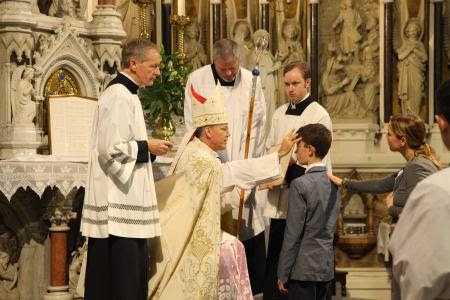
Last Sunday 11 children and one adult were confirmed in the Tridentine Rite by the Papal Nuncio, Archbishop Charles Brown in St Kevin's Church Harrington St, Dublin. Archbishop Brown is pictured confirming Rian Wood at the ceremony.

Thursday, October 23, 2014

Pope Francis and the synod

Letter in today's Irish Times.
Sir, – I read and re-read Fr Vincent Twomey’s article (“Synod feeds secular agenda hostile to traditional family”, Opinion & Analysis, October 18th) several times and then it struck me! Think how much confusion would have been avoided if God had placed a few orthodox theologians alongside Jesus Christ, just to keep him on the right path.
They could have enforced a more rigid theology than the simplistic approach adopted by Jesus and his sidekick Paul, who, in his letter to the Corinthians, placed rather too much emphasis on love. – Yours, etc,
SEAMUS DOOLEY,
Dublin 8.

People of Zambia celebrate fifty years of independence

Tomorrow, October 24 Zambia will celebrate 50 years of independence.

Below is a talk given last evening by the writer of this blog at the  Dublin Chamber of Commerce to Concern supporters, individual and corporate donors.


Hello and you are welcome here this evening to the Dublin Chamber of Commerce. At the end of May beginning of June I was in Western Zambia. It has been a life-changing experience.

Concern is in Zambia since 2001 when we went there in response to a food crisis. This year we are spending €2.2 million in the country

In Mumbwa District we visited a village where Concern is working. Before we got up to leave we had a short question and answer session. I asked Monica Malundu what she would most like to have in life. “Water,” she said spontaneously.

Monica can do two round trips of six kilometres a day to get water for her family.

I got into the car and while driving on to Kaoma, passing people carrying water I was thinking of Monica’s answer to me.

But these days I’m watching the water we so much take for granted. How much water did you waste yesterday? How much food did we waste yesterday? How much food is thrown from fridge to bin?

Do you know that the world’s nearly one billion hungry people could be lifted out of malnutrition on less than a quarter of the food that is wasted in the US and EU.

I have no problem at all saying I have no answers to anything. But after my week in Zambia I keep thinking of the fortune of being born somewhere and the misfortune of being born somewhere else. Bono once said “Where you live should not determine whether you live.”

I stared into the eyes of beautiful children and wondered why. But every time I did that I also realised the amazing work that Concern is doing in Zambia.

Zambia is a large country. 753,000 Sq KM. Ireland is circa 84,000 Sq Km yet the population is only 13.5 million. Life expectancy is 49

English woman Danny Harvey runs the Concern operation from Lusaka.
Approximately 60 people work for us in Zambia.

We were sort of a VIP team, Frances O’Keeffe. Frances is right now in South Sudan. Evanna Barry, who has just retired after 20 years on Council. She worked in Bangladesh in the early 1970s, Dominic MacSorley and representing the hoi polloi, myself. People often think the hoi polloi are the upper class, no, the plebs.

The work ethic of the chairperson and CEO is really spectacular. I have a fair good energy level but in Zambia I often found myself running fast to keep up with Frances and Dominic. 

We drove from Lusaka to Mongu with an overnight stop in Kaoma. The road from Lusaka to Mongu is a straight line for 600 kms built by the Dutch in 2005.

I can still see this tall slim man near Mongu show us his small farm holding where he is using methods of farming, which he has learned from Concern advice. He may not call it ‘conservation farming’ but that’s exactly what it is. He is planting seeds with the minimum of soil disturbance by using simple tools. The soil is covered throughout the year, which means the soil is cool and moist and retains its natural structure. He explained too about crop rotation.
This project is funded by Accenture and Irish Aid in Zambia and Malawi. Accenture is one of the world’s biggest consulting companies. Right now Concern is in the second year of a three year partnership programme with Accenture. Accenture has given us $3.25 million for the three-year programme. And this is the second three-year-programme that has been funded by Accenture. Thank you Accenture.
We visited Concern programmes in Kaoma. It was here I met village elder James Nsuuma.

He welcomed us in his native language Sala, and Annie Nyiremda translated. Annie works for a Concern partner. She is married and has two children. Her husband works with the Zambian forestry and part of his job is to protect trees being felled for charcoal purposes. All along the road from Lusaka to Mongu I saw felled timber for charcoal use.

James is the headman for 25 families and he in turn reports to a chieftain. His job entails implementing government policy in the village. “I have to make sure that there are no rapes or instances of child abuse. That is the most recent instruction I have received from the Government in Lusaka,” he said.

Innovative and exciting are the two words I’d use about the Concern programme in this village.

It is centred around helping pregnant and lactating women and children up to two years of age. The focus is on the nutrition of the mother from conception until the child reaches its second birthday. It’s the 1000 Days concept.

On one occasion I caught Frances O’Keeffe asking the age of a child. She was told he was 10. He looked more like five. A clear example of stunting and of course but for Frances’ sharp eye I would never have spotted it.

It really is a brilliant programme to help in the fight against malnutrition and such a clever idea. It means the local people are cultivating all sorts of new crops with high nutritional value. At first many of the men were sceptical about the programme but now that they are seeing the results they are being won over.

Families are growing these seeds on small areas of land. I saw mbereshi, which is an iron enriched bean, soya beans and pumpkin seeds. I also saw orange fleshed sweet potatoes which have more vitamin A. Most of these are new to the area.

The programme, which is called RAIN - Realigning Agriculture to Improve Nutrition - a long handle but is saying exactly what’s on the tin, is funded by Irish AID and the Kerry Group and of course the Irish public

The next time you see a Kerry truck, fry their sausages, eat their butter or drink their milk remember they are giving Concern €1.25 million over four years for this programme. 

The villagers had a special programme prepared for us, which included dancing and a drama which explained how the initiative is improving life, and especially for women.

Accompanying us for the whole of our visit was Patrick McManus from the Irish Embassy. Patrick is head of development at the Embassy. He came to Mongu with us. It was his first time to see the Concern programmes supported by Irish Aid.

I sat in the back seat with Patrick for 600 kilometres from Mongu to Lusaka. I had never been so long in the back seat of a car. Actually I was dreading it but it turned out to be one of the most enjoyable journeys I have ever undertaken. 

Patrick worked for Concern in Belfast and Bangladesh and was country director in Haiti before moving to the Department of Foreign Affairs. In fact he set up the Haiti Concern operation in 1994. 

And at one stage Charlton our driver roared at me to get back into the car. Driving through Kafue National Park we stopped and I jumped out to take a few pictures. Suddenly I heard Charlton scream my name. I should not have been out of the car. A lion could be waiting for me.

Those of you who may have seen the Radharc programmes will have heard the name Joe Dunne. Joe, who was in Africa doing some filming wrote back to the Archbishop of Dublin John Charles McQuaid asking could he stay on longer to film lions and tigers. McQuaid wrote back giving him permission but adding that there are no tigers in Africa.

In Mongu we saw what the Concern Graduation programme is doing.

It targets people Concern believes can graduate out of poverty.

I spoke to Mushimbei Mwendabai. Concern gives her 30 Kwachas a month - €3. It allows her build up a little head of steam, buy and sell her produce and send her older child to school. The money is transferred through a local bank.

Liam Kavanagh from Coolock works in Mongu. He is 28, did Development Studies in UCC and is a gem of a person. I asked him what he plans to do in the future. His reply – “Can’t see myself doing anything else”.

What a committed young man. Local people call him affectionately Mukavesa, meaning white man.

Liam is working on the graduation programme and keeps a close eye on those who are taking part in it.

On our last day in Lusaka we were invited to the Irish Embassy and Ambassador Finbar O’Brien, no not from Cork, as you might think, with a name like that, but Athlone, received us with open arms and we were lucky to arrive the morning we did as they were having a special coffee morning for homeless children. We had to walk round the garden bare foot. It actually suited me because I was on my last pair of socks.

The ambassador filled us in on the current political situation in the country and it was most informative.

When I landed back in Dublin I made a promise that I would challenge anyone who would talk about Concern wasting money.

It was an incredible journey into the unknown.

I came home knowing so much more about what Concern is doing in far off Zambia.

I also came home a new man. Terribly proud to work here and to be Irish too.

It’s your support, effort, generosity that makes Concern happen. And your effort manifests itself in all forms and shapes, individual, corporate, school adjudicators, fund-raisers, trekkers, all of you.

Life changing.

Jesus and paradox?

This blog would be interested in an explanation of today's Gospel.

The current 'Scripture and Church' writes that Jesus often acts and talks in paradoxical terms.

Wednesday, October 22, 2014

The Catholic Church's public stand on homosexuality

The piece below is from the NCR.
If every gay priest, bishop, cardinal admitted publicly his sexual orientation how many priests, bishops and cardinals would actually be left standing?
"US bishops, their lawyers and personnel directors have some hard choices to make in the next few weeks. What will they do with Catholic employees who enter valid legal marriages with partners of the same sex? To date, their track record on this issue has been bleak.
"At least 17 U.S. church employees have been fired, resigned, refused to renew restrictive contracts, or had job offers rescinded over LGBT-related employment disputes this year. Catholic school teachers and parish music ministers have been fired because their same-sex marriages became public. In many cases, these were employees of long standing who were well-respected by their school and parish communities. Often, the communities already knew the employees' partners. There was no problem until they entered legal, civil marriages."

Tuesday, October 21, 2014

Tourism Ireland 'products'

Niall Gibbons CEO of Tourism Ireland on Morning Ireland referred to the Wild Atlantic Way as a 'great product'.

Yuk.

'You can't build wall around west Africa', Concern CEO

The piece below appears in this week's INM Irish regional newspapers.

Michael Commane
Concern Worldwide’s CEO Dominic MacSorley gave a talk in Tralee on Thursday evening.

Readers who are familiar with Concern will know that its origins began over 40 years ago when it was a volunteer-based organisation. Nurses, doctors, plumbers, teachers and engineers volunteered to work for periods of time in places such as Bangladesh, Ethiopia and Sudan.

The volunteer aspect of the agency has changed and today Concern employs over 3,000 people worldwide. Its work is still exactly the same – supporting and helping the poorest of the poor.

Dominic MacSorley was in Tralee to say thank you to people in Kerry who help with their time and money.

In the past the people who attended these meetings were those who had volunteered to work for Concern in poverty stricken countries. Today the meetings are arranged to keep Concern supporters informed of what the agency is doing. Without the generosity of the Irish public Concern could not do the work it is doing.

Some people when they heard that Dominic was just back from Sierra Leone and Liberia they expressed a certain worry about coming along to the meeting. One man said that he would not be attending because he was afraid he might pick up the dreaded Ebola. 

My first reaction was one of annoyance and I pointed out that Ebola can only be transmitted by touch and the exchange of bodily fluids. But thinking about it, it is such a health hazard, I can understand why someone would be scared to be anywhere near anyone who has been at the epicentre of this horrific health issue. 

But it’s also important to be aware of the facts and know exactly how the virus is transmitted. Wrong information and myths can do terrible harm.

It so happens the Tralee meeting was well attended.

Dominic spoke about issues surrounding Ebola. He stressed the safety and security precautions that have been taken for Concern staff in Sierra Leone and Liberia. He stressed that it is safe to visit the countries.

“You can’t build a wall around west Africa. We have very strict protocols in place. You must never touch anyone and it is essential to keep washing your hands. People are now accepting this. This is a big cultural shift.

“Seventy eight per cent of those who have died from Ebola have had direct contact with the bodies of people who have died from Ebola. It’s mostly women who do this work so more women are dying from the disease," Dominic said.

The United States is building 27 treatment centres in Liberia and these will be in operation by November.

He referred to how charities have been in the limelight in recent months and for all the wrong reasons. But he added that Concern has been at the vanguard in pushing for transparency and good practice in the sector.

Dominic, who has been working with Concern for 32 years was appointed CEO in May 2013. He has worked in 16 of the poorest countries on earth.

He knows what it’s like for people who live lives of horror and deprivation. But he also knows how the generosity of  Irish people is making real inroads into alleviating their plight.

Last week students from Largy College in Clones, who won this year’s Concern national debate competition, spoke about their visit to Concern programmes in Bangladesh at a venue in Dublin.

They saw first-hand what Concern is doing. They are now ambassadors to other young people on the importance of this work. 

Seeing is believing.


Monday, October 20, 2014

Mairia Cahill

Simply, Mairia Cahill is a sensational woman.

Obama and Francis

A US president in the second half of his second term, especially if he has not a majority in Congress, is referred to as a lame duck president.

Is this now the plight of Pope Francis?

Would it be interesting to know how many of the voting prelates at the synod are closet gay men?

Would it be more interesting to know how many of those who voted for no change are closet gay men?

Sunday, October 19, 2014

Walking away

"I have stopped going to Hoy Cross. I can't take it any longer."

A comment from someone who has been attending the Dominican church in Tralee for over 50 years.

The back entrance to the Dominican Priory in Tralee featured on this blog last week.

Featured Post

'Until you face your shadow it will destroy you'

The link below is well worth a listen. Until you face your shadow it will destroy you - Carl Jung Is he talking about what Christians call O...